



Hamidul Hossain Siddiqui
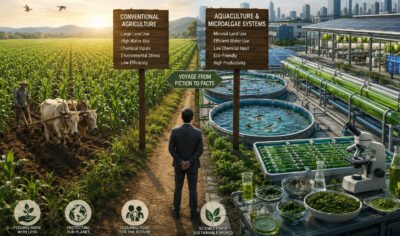
With the blessings of modern technology, volume or size of many articles/machines are compressed specially the books, libraries containing numerous words/ books reduce to tiny discs, CD s, pen drives & so on. These brought about magic advances, but still we are plowing hundreds of corn fields, irrigating, fertilizing, controlling pests & combating many other environmental constrains as drought, flood, salinity etc. these all remind us of the carts pulled by cows, postman riding on horses, telegraphic age, etc. Could we not think “our wide corn fields of thousand acre reduced to little plots of the size of roofs of our buildings retaining production unimpaired?”
This may off course seem impossible or otherwise complicated! With the help of a little in depth ideas of science of production it can be proved(not to confuse like “ may be”)possible that can be termed “a route from fiction to facts”
A critical but simple perception is sought amiably to the discourse followed:
The effect of advancement of science & technology on the balance of nature or environmental stability had been scrutinized for last few decades.
The green revolution, though helped doubling of agro production, it laid some irrecoverable consequences on the environment. termed “ecological Backlashes”. It resulted in extinction, endangering or threatening of many Biological species mainly fishes, birds
landscapes & vegetation due to salinity, (Over fertilizing) toxicity,(pesticides) acidity(industrial gases as So2) etc.
On the contrary man has shortened time of travelling, compressed the volume of libraries within tiny discs as alluded before. Information’s are taking least or no time to reach a remotest receiver; all of which are stimulating technological advancements. All these advances have one thing in common that they are serving around entertainments or comforts or transport, not For basic production as discussion indicated. For the basic need of food man are still cultivating large areas of crop fields, where the labour, cost & size are not reduced technologically. Instead production though doubled in many cases the attainment thereby can not be compared to that of Electronics, such as Libraries reduced to Compact Disc. Can not we expect our expanding large crop fields to get reduced to tiny blocks as the roof of our buildings keeping the production unimpaired, even more & qualitative & controlled? Let us recall things realizable from modern technology specially Biotechnology.
To myself as to many others who perceives as or more than me it appears quite possible. basics of feasibility of such production enterprise can be summarized as follows:
- Plants weighing several tones contain minerals only several kilograms. The rest weight is actually made up from Air & Water of the atmosphere by the process of Photosynthesis.
- Multicellular advanced Plants i.e. trees, herbs etc take months or years to attain reproductive stage, while simple unicellular plants/organisms such as Algae, takes from hours to days for doubling by weight or number. [eg. a goat weighing 10 kg may take two years to become 20 kg but 10kg Algae in the morning may become 20 kg in the evening]
- Minerals take longer time to be released or recycled in terrestrial system, while in aquatic system it take logarithmically less time.
3) A fraction of biomasses received from higher plants as food for man or animals while almost 65% or more of dry weight of simple aquatic plants may be taken as food for animals as well as the men.
An analytic explanation in support of this idea can be speculated as follows:
- All the bimoleculas are Glucose or it’s(C6H12O6) derivatives at different levels
- Of C6H12O6 C & O comes as CO2 From atmosphere, not from soil
- C6H12O6 is a by product of H2O, fresh water of soil or marine water, where source of soil water is again atmosphere, I e rain water
- Thus the whole molecule C6H12O6 has it’s origin as atmosphere, the soil only supplies a very little % of fresh or dry weight for metaboly(the minerals that can be regulated by man at will)
- Therefore we can derive a conclusion that productivity does very little correlativity to soil & it mainly derives its near 100% content from atmosphere. In this way it can be stated that Technology and not land size is determinant of productivity.
The above points are to realize the significance of aquaculture where phytoplanctonic Agae (for example) may be used for food & biomass for both mankind directly and other productive crops such as fishes. Aquatic ecosystems are more efficient in productivity. Thus if aquaculture Is established in practice it would render sufficient
space for nature & save enough time of mankind at the sometime. Contrary to present sedentary or shifting cultivation based agriculture, seizing much natural land creating pressure on environment, aquaculture appears more effective & economic.
Shifting from modern agriculture to advance aquaculture may appear primarily as a much sophisticated leap but with time it may become successful with great relieve from complicated endeavors of land, pest ,water & waste management. The same had been on practice since last several decades in Japan, Thailand, Korea, India etc . Therefore we could leave larger areas of land for forests or natural vegetations, Ecosystems keeping little space for cultivation, in which more fast & efficient simple plants (Phytoplankton’s & allied) would be selected and Cultured, not cultivated. Thus both man & environment would be benefited.
The writer is a former Professor of Botany, Chittagong College, Chittagong.
