



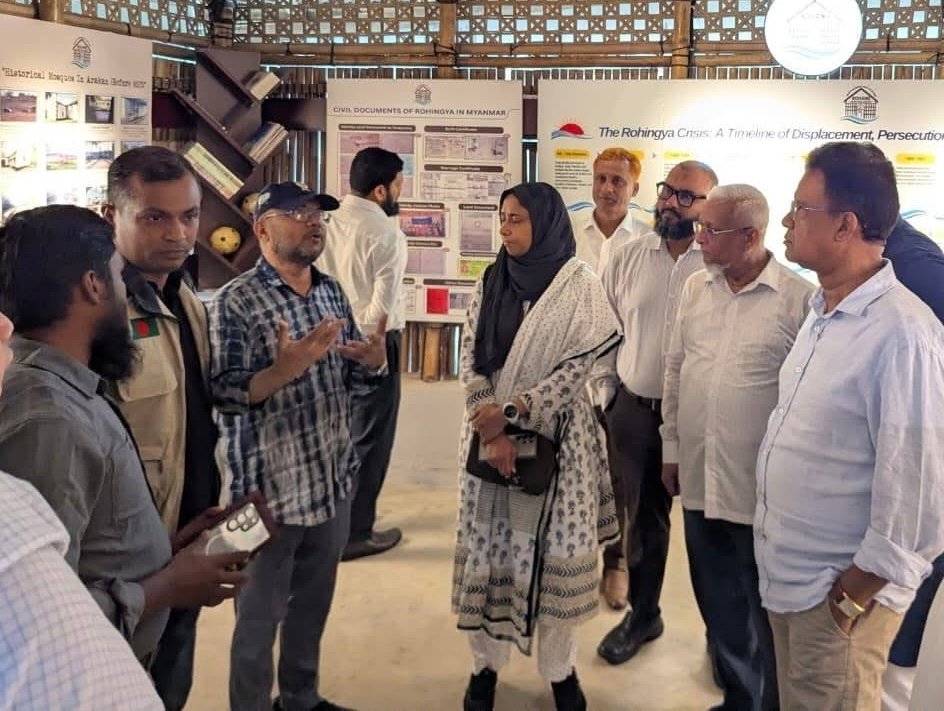
A parliamentary delegation from Bangladesh’s Standing Committee on Foreign Affairs has visited Rohingya refugee camps in Ukhiya, Cox’s Bazar, to assess humanitarian conditions, engage directly with displaced communities, and reaffirm repatriation to Myanmar as the ultimate aspiration for resolving the protracted Rohingya crisis.
Facilitated by the Refugee Relief and Repatriation Commissioner (RRRC), Thursday’s visit brought together lawmakers, government officials, humanitarian agencies, and Rohingya youth representatives for a series of field-level engagements covering cultural preservation, healthcare, food assistance, refugee verification, and inter-agency coordination.
The visit underscored Bangladesh’s continuing commitment to addressing the humanitarian needs of the forcibly displaced Myanmar nationals (FDMNs), while highlighting a central challenge: how to translate the longstanding political commitment to repatriation into a practical, voluntary, safe, dignified, and sustainable process.
The delegation was led by Parliamentary Standing Committee on Foreign Affairs Chairperson Jahrat Adib Chowdhury, MP, accompanied by committee members S K Azizul Bari, Sayeed Al Noman, Sanjida Islam, and Mir Ahmad Bin Quasem.
From humanitarian assessment to a durable solution
The delegation’s itinerary offered a broad overview of the institutional and humanitarian arrangements sustaining the Rohingya response in Bangladesh. Its engagements also illustrated the interconnected nature of the crisis, which extends beyond the provision of immediate assistance to questions of identity, rights, security, accountability, and the future of an entire displaced population.
At the Rohang Heritage Centre in Camp 6, Camp-in-Charge Gazi Shariful Hasan briefed the lawmakers on Rohingya history, cultural identity, and historical heritage. The visit highlighted the importance of preserving collective memory and cultural identity among a population whose displacement has disrupted established social structures and community life.
Cultural preservation is an important dimension of any durable solution. For the Rohingya, the ability to maintain their identity and heritage is closely linked to the broader question of whether their rights and dignity can be protected in any future return to Myanmar.
The visit therefore placed the humanitarian emergency within a wider context: assistance can sustain displaced communities, but a lasting resolution requires conditions that allow them to live securely, preserve their identity, and exercise their fundamental rights.
Healthcare and food assistance remain critical pillars
At the Turkish Hospital in Camp 9, the delegation observed healthcare services delivered by Turkish medical professionals to Rohingya beneficiaries. The visit highlighted the role of humanitarian medical facilities in meeting the healthcare needs of displaced people living in densely populated camps.
The lawmakers subsequently visited a World Food Programme (WFP) food outlet in Camp 4, where they received a briefing on food distribution mechanisms and assistance delivery.
These visits brought attention to two essential components of the humanitarian response: access to healthcare and reliable food assistance. Both are fundamental to protecting the well-being of refugees, particularly vulnerable households facing prolonged displacement and uncertainty.
However, the continued importance of these services also reflects the structural challenge facing Bangladesh and its humanitarian partners. The longer the displacement persists, the greater the need to sustain essential services while balancing humanitarian requirements, available resources, and the search for a durable solution.
Effective assistance must therefore remain needs-based, transparent, and accountable. At the same time, humanitarian support should complement, rather than replace, efforts to create conditions for a lasting resolution.
Rohingya youth reiterate hopes for repatriation
One of the most significant engagements took place in Camp 4, where the delegation met youth representatives of the United Council of Rohingya (UCR).
The lawmakers listened to the concerns and aspirations expressed by the Rohingya youth and assured them of their commitment to extending all possible support towards repatriation.
The interaction placed refugee voices at the centre of the visit, reinforcing the importance of consulting displaced communities when discussing their future. Rohingya youth, in particular, have a direct stake in decisions concerning education, livelihoods, identity, security, and the prospects of rebuilding their lives.
The delegation reaffirmed that voluntary, safe, dignified, and sustainable repatriation to Myanmar remains the ultimate aspiration of the Rohingya people.
Yet the distinction between aspiration and implementation remains critical. Repatriation cannot be assessed solely by the willingness of refugees to return or by political expressions of support. Its sustainability depends on credible guarantees that returnees will be protected from renewed persecution and displacement, have their rights and identity recognised, and be able to live with security and dignity.
The delegation’s assurance of support signals political engagement, but translating that commitment into results will require sustained diplomatic efforts, effective international cooperation, and meaningful progress towards conditions conducive to return in Myanmar.
Verification and coordination underpin the response
Following the youth consultation, the delegation visited the UNHCR–RRRC Joint Verification Centre to receive information on the protracted crisis, the prevailing humanitarian situation, and ongoing verification processes.
Verification is an important operational component of refugee management, helping authorities and humanitarian partners maintain reliable information on displaced populations and support the planning and delivery of assistance.
The visit also provided lawmakers with an opportunity to examine the institutional mechanisms through which Bangladesh and its partners manage the Rohingya response.
The delegation later attended a consultation with officials from relevant government departments, representatives of United Nations agencies, international non-governmental organisations, and national NGOs.
The meeting provided a platform to exchange perspectives on humanitarian needs, operational challenges, coordination, and the way forward.
Such consultations are particularly important in a crisis involving multiple government institutions and humanitarian actors. Differences in operational priorities, resource constraints, and evolving needs require effective coordination to ensure that assistance reaches beneficiaries and that policy decisions reflect conditions on the ground.
For parliamentary policymakers, direct engagement with implementing agencies can also help connect field-level realities with foreign policy discussions and institutional oversight.
Parliamentary confidence meets the realities of repatriation
After the day’s engagements, Chairperson Jahrat Adib Chowdhury and members of the delegation addressed the press, expressing optimism about the prospects for repatriation and reaffirming their belief that a lasting solution remains achievable.
They called for continued support, solidarity, and cooperation, stressing that collective efforts and a shared commitment would be essential to turning that aspiration into reality.
The message conveyed confidence in the possibility of progress. However, the principal challenge remains how to convert that confidence into measurable advances.
Myanmar’s political and security conditions, the protection of Rohingya rights, guarantees against renewed persecution, and the establishment of an environment conducive to voluntary return remain central considerations in any credible repatriation process. These factors cannot be resolved through humanitarian interventions in Bangladesh alone.
A sustainable outcome will require continued diplomatic engagement with Myanmar, cooperation from relevant international actors, and arrangements that allow refugees to make informed decisions about returning without coercion.
It will also require the international community to maintain attention on the crisis rather than allow prolonged displacement to become an accepted status quo.
The parliamentary delegation’s visit did not, in itself, establish a timetable or concrete mechanism for repatriation. Its significance lies instead in reinforcing political attention, bringing lawmakers into direct contact with the humanitarian response, and renewing public emphasis on a durable solution.
The way forward
Bangladesh continues to shoulder substantial responsibilities as the host country for a large Rohingya refugee population. Maintaining humanitarian assistance, protecting the dignity of displaced people, and pursuing a sustainable solution remain parallel priorities.
The visit demonstrated the value of parliamentary engagement in understanding the operational realities of the crisis and communicating the aspirations of displaced communities. It also highlighted the need to move beyond repeated declarations of commitment towards coordinated diplomatic action, clear policy priorities, and sustained international support.
For Rohingya refugees, repatriation represents more than a physical return across a border. It is tied to the prospect of living without fear, recovering their rights, preserving their identity, and securing a future for the next generation.
The ultimate test of the renewed optimism expressed by the delegation will therefore be whether political engagement produces tangible progress towards those conditions.
The RRRC reiterated its commitment to effective humanitarian coordination, the dignity and well-being of the FDMN population, and concerted efforts towards a durable solution through voluntary, safe, dignified, and sustainable repatriation.
As the crisis continues, the challenge for Bangladesh and its international partners remains clear: sustain humanitarian protection in the present while pursuing the political and security conditions necessary to make a lasting solution possible.
