



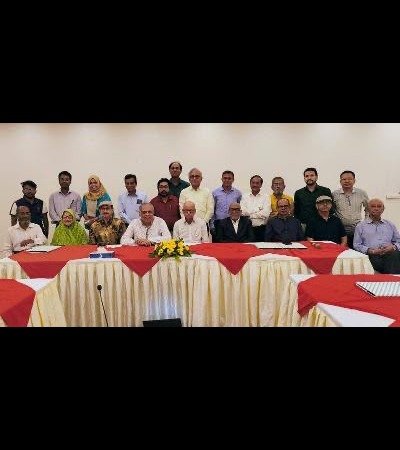
News media stakeholders have called for coordinated action to advance policy discussions and implement the recommendations of the Media Reform Commission. They said that comprehensive structural reform, rather than isolated and partial measures, is essential to protect editorial independence, ensure professional and financial security of journalists, and restore audience trust. They also emphasized the need to strengthen self-regulatory mechanisms within news outlets.
They made the observations at a divisional consultation in Chattogram, organised by Media Resources Development Initiative (MRDI) under the Canada Fund for Local Initiatives, funded by the Canadian High Commission in Bangladesh.
The consultation was the fourth in MRDI’s series, following those in Khulna, Barishal and Sylhet. News media owners and publishers, editors, news managers, journalist union and association leaders, university teachers and civil society representatives from Chattogram and other districts attended.
MRDI Executive Director Hasibur Rahman said effective self-regulation would reduce scope for external interference and help protect media freedom as he stressed the need for separate codes of conduct for editors, owners and journalists.
Kamal Ahmed, former chief of the Media Reform Commission and consulting editor at The Daily Star, said the recommendations reflected consensus across the industry.
Piecemeal legal amendments will not resolve the media landscape’s problems, he said, calling for comprehensive structural reform, an independent permanent media commission, and self-regulation based on an ethical code of conduct.
Rejoanul Haq Raja, director of News and Current Affairs at Channel S, said media outlets must establish internal accountability before demanding it from others.
Participants said the Media Reform Commission’s recommendations require transparent, coordinated and time-bound action adding that ethical journalism depended on financial security and urged media owners to ensure timely salaries, formal appointment letters, and lawful benefits and safe working conditions.
Speakers also called for national media policy discussions to better reflect the experiences of community outlets and journalists outside Dhaka.
M A Malek, Editor, Dainik Azadi; Dr. M Ramizuddin Chowdhury, Editor, Dainik Purbokone; Rusho Mahmud, Editor, Suprobhat Bangladesh; Osman Gani Mansur, Editor, Daily People’s View; Zahidul Karim Kachi, President, Chattogram Press Club; M Ali Hossain, President, Chattogram Editors’ Club; Golam Mawla Murad, General Secretary, Chattogram Reporters Forum; Jesmin Sultana Paru, Chief Executive, Ensure Legal Support through Local Movement and Action (ELLMA); S M Nazir Hossain, Executive Director, Integrated Social Development Effort (ISDE); Shahab Uddin Nipu, Head of Department, Department of Communication and Journalism, University of Chittagong; Yaser Silmi, Head of Department, Journalism and Media Studies, BGC Trust University Bangladesh; Dilruba Akter, Head of Department, Journalism and Media Studies, Port City International University; Shamsul Haque Haidari, Former President, TV Journalists Association Chattogram; Anwar Al Haque, Editor, Dainik Rangamati; Amirul Islam Harun, Editor, Dainik Sachitra Noakhali; Ripon Chakma, Executive Director, Trinomul Unnayan Sangstha; and Mahmudul Hasan, Assistant Professor, Department of Mass Communication and Journalism, Comilla University were among others present on the occasion.
