



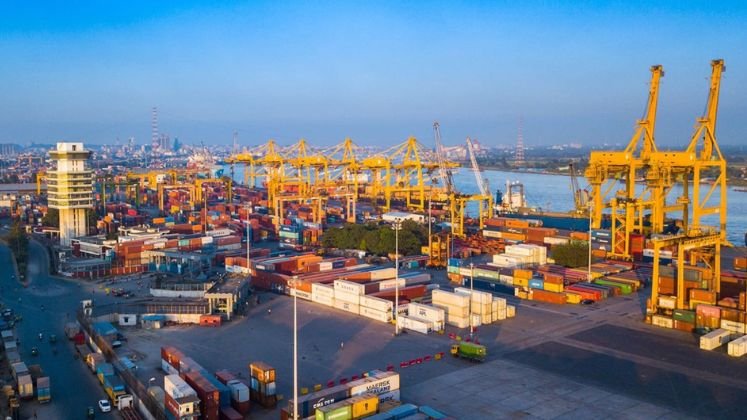
The government on Thursday decided to hand over the New Mooring Container Terminal (NCT) of Chattogram Port to an international terminal operator for 15 years, approving the draft concession agreement for the operation and maintenance of the country’s largest container-handling facility.
The approval, granted in principle by the Cabinet Committee on Economic Affairs (CCEA), marks a major step forward in the long-running initiative to bring Dubai-based global port operator DP World into the operation of the strategically important terminal.
The proposed concession also includes the adjacent Overflow Container Yard (OCY) and will be implemented under a Public-Private Partnership (PPP) framework.
Finance Minister Amir Khasru Mahmud Chowdhury chaired the 31st meeting of the CCEA at the Cabinet Division in Dhaka, where the Ministry of Shipping placed the proposal.
According to the government’s Public-Private Partnership Authority, the Chittagong Port Authority (CPA) plans to award a government-to-government concession to DP World, nominated by the Government of Dubai, for upgrading, operating and maintaining NCT.
The latest approval, however, is an in-principle clearance of the draft agreement and does not itself mean that the terminal has already been handed over. Further government and contractual procedures will be required before the concession takes effect.
DP World deal moves closer to implementation
The NCT operation initiative originated during the previous government, which granted initial in-principle approval to the PPP project on March 23, 2023.
The International Finance Corporation (IFC), a member of the World Bank Group, was subsequently appointed transaction adviser to assist the CPA and PPP Authority in conducting due diligence, structuring the transaction, preparing the request for proposal and concession agreement, and facilitating negotiations with the selected international operator.
The project has an estimated cost of US$205 million, according to the PPP Authority’s project profile.
Negotiations gained momentum under the interim government but remained incomplete amid disagreements within the negotiation process and objections from labour groups.
The process was suspended in February before being revived under the present government.
In April, DP World proposed operating NCT together with the Chittagong Container Terminal (CCT) as an integrated facility. In May, the Shipping Ministry directed the CPA to reconstitute its evaluation committee, while the port authority subsequently formed a 12-member support team to assist negotiations.
The latest approval represents a further move towards finalising the arrangement.
NCT handles nearly 44% of port containers
The decision carries particular significance because NCT is the largest container-handling facility at Chattogram Port, the principal maritime gateway for Bangladesh’s international trade.
The terminal handled around 1.3 million TEUs (twenty-foot equivalent units) annually, accounting for approximately 44 percent of the port’s total container throughput, according to published port data.
Since July 2024, NCT has been operated by Chittagong Dry Dock Limited, an enterprise under the Bangladesh Navy.
Under its management, the terminal recorded its highest-ever monthly container throughput of approximately 126,000 TEUs in May 2026.
The proposed foreign operation would therefore place a major share of Bangladesh’s container logistics under an international operator, with implications for port efficiency, investment, revenue generation, labour and long-term management capacity.
Government’s position and outstanding questions
Shipping Secretary Zakaria earlier told journalists that the ministry had submitted the proposal for review and could not comment until receiving the committee’s direction.
“We have submitted the proposal for review of the committee. Until we receive any direction from the committee, we cannot make any comment,” he said.
The latest approval has also revived concerns among port stakeholders over transparency, the financial structure and the long-term implications of the concession.
The Chattogram Port Protection Committee, in a statement issued on Thursday, questioned why the proposal was placed under the CCEA’s miscellaneous agenda rather than its main agenda for detailed discussion.
“Why was the issue not presented and discussed in detail under the main agenda?” the committee leaders asked.
The committee, led by Convener Engineer Delwar Majumdar and Member Secretary Fazlul Kabir Mintu, called for publication of the draft concession agreement and independent scrutiny of its key provisions, including revenue sharing, investment commitments, employment, security, risk allocation and termination or renegotiation clauses.
The committee’s objections reflect concerns over public disclosure and accountability; they do not alter the government’s in-principle approval.
A wider shift towards international terminal management
The NCT initiative is part of a broader transformation of Bangladesh’s port infrastructure through foreign investment, private-sector participation and international terminal management.
Saudi Arabia-based Red Sea Gateway Terminal is already operating the Patenga Container Terminal under a 22-year concession.
The government has also moved forward with the development and operation of the proposed Laldia Container Terminal by Denmark-based APM Terminals under a long-term PPP arrangement.
Unlike Laldia, which is a greenfield development, NCT is an existing operational facility built with substantial public investment.
The proposed 15-year concession will therefore be closely watched for its impact on the CPA’s institutional role, public investment returns, operational efficiency and Bangladesh’s control over a critical trade gateway.
The final concession agreement is expected to determine the operator’s investment obligations, operating standards, revenue arrangements, responsibilities and other contractual conditions.
The immediate challenge for the government will be to translate the approval into a transparent and commercially viable agreement while addressing concerns over national economic interests, port workers and the future role of the Chittagong Port Authority.
