



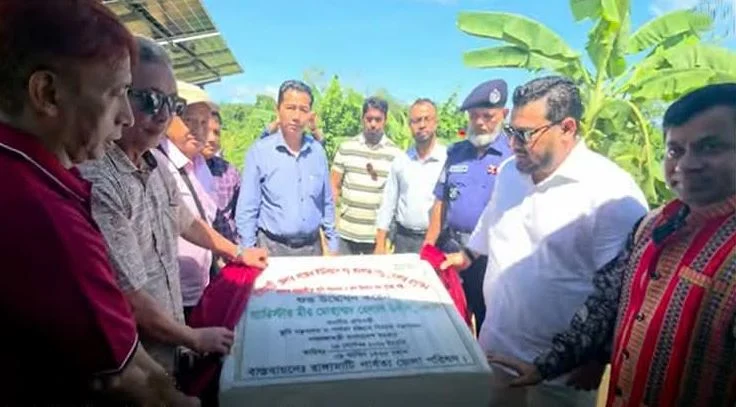
RANGAMATI, Sept 24: For generations, residents of remote hill settlements have had to descend steep slopes to collect water from springs and streams and then carry heavy containers back uphill to their homes. A new solar-powered initiative now aims to ease that daily hardship by bringing water closer to households while expanding irrigation facilities for agriculture.
State Minister for Chittagong Hill Tracts Affairs Mir Mohammad Helal Uddin said the government was exploring practical and sustainable solutions to the longstanding water crisis in remote hill communities.
He made the remarks on Thursday while inaugurating a project to improve household water supply through solar-powered systems and expand agricultural irrigation facilities for disadvantaged hill communities at Bara Konglak Para in remote Sajek Union of Baghaichhari upazila, Rangamati.
The initiative is expected to reduce the need for residents—particularly women and children—to make difficult journeys downhill and back up again to collect water.
“The real problems of people living in remote hill areas cannot be fully understood by sitting in Dhaka. We have to see the situation on the ground and find practical and sustainable solutions based on local needs,” Mir Helal said.
A daily struggle for water
Access to safe water remains one of the most pressing challenges for many communities in the more isolated parts of the Chittagong Hill Tracts.
Difficult terrain, scattered settlements and limited infrastructure have made conventional water-supply systems difficult to establish in many remote areas. In some communities, water sources are located far below the settlements, forcing residents to negotiate steep and rugged paths every day.
The burden falls disproportionately on women, who often remain responsible for collecting water for their families.
The new initiative seeks to bring water closer to households while also supporting agricultural irrigation in these hard-to-reach communities.
‘You cannot understand the hills by sitting in Dhaka’
Mir Helal has emphasised the need to understand the distinctive realities of hill communities before designing development projects for the region.
Problems faced by people in the hills are often fundamentally different from those encountered in the plains, he said. Development models designed for flatland communities therefore cannot simply be replicated in the hills without considering local geography, accessibility and community needs.
He said field visits were being conducted across remote areas of the three hill districts to identify problems firsthand and develop appropriate solutions.
More than just water
The benefits of reliable water access could extend well beyond easing the daily burden of collecting drinking water.
If women and children spend less time travelling to distant water sources, children could devote more time to education while women could pursue livelihoods and other productive activities. Better access to water could also improve hygiene and public health and support small-scale agriculture.
The irrigation component of the initiative could further strengthen local livelihoods by allowing farmers to make more effective use of cultivable land.
A different measure of development
Development in the Chittagong Hill Tracts is often discussed in terms of roads, major infrastructure and tourism. But for people living in remote hill settlements, development can begin with much more basic needs—safe drinking water, healthcare, education, electricity and access to livelihoods.
The solar-powered initiative at Bara Konglak Para places one of those fundamental needs at the centre of development planning.
If successful, the model could potentially be replicated in other remote communities where water is available at the foot of the hills but remains difficult to access for people living on the slopes.
For families who have spent generations carrying water uphill on their heads, the prospect of using sunlight to bring water to their homes could mark a significant change in everyday life.
