



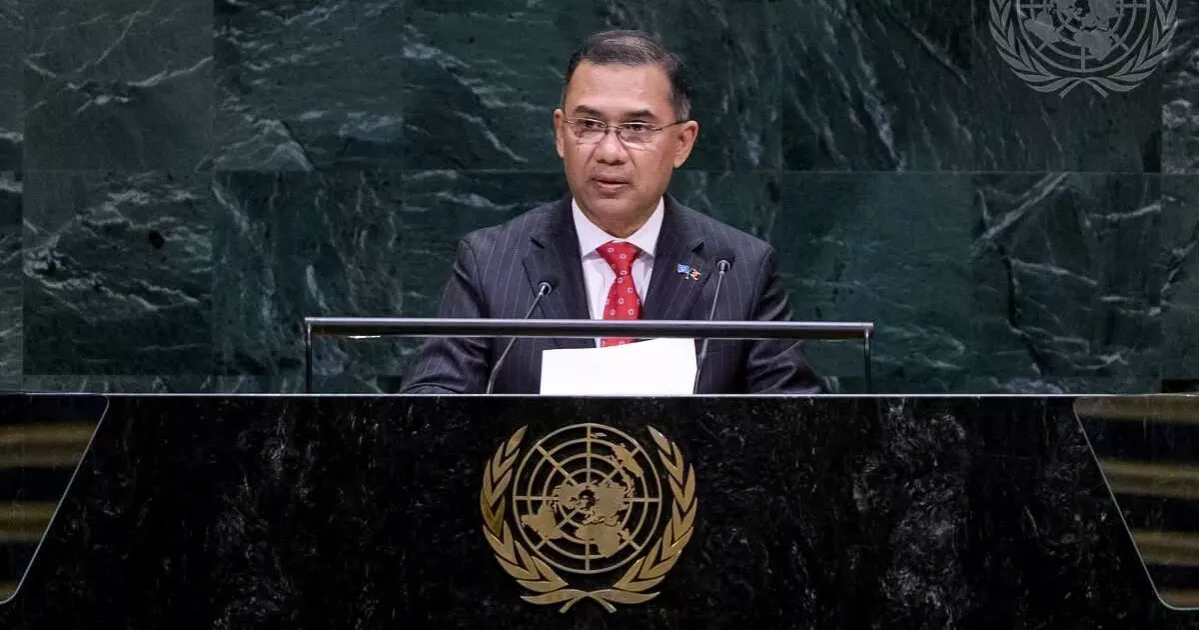
NEW YORK, Sept 25: Prime Minister Tarique Rahman has declared Bangladesh’s return to the “path of democracy” before the international community, outlining a three-pronged strategy of Recovery, Restoration and Reconstruction to rebuild the country after what he described as a prolonged period of “fascist rule and exploitation.”
Addressing the general debate of the 81st session of the United Nations General Assembly (UNGA) on Thursday, the Prime Minister placed democracy, political and economic empowerment, human rights, accountability and social inclusion at the centre of his vision for Bangladesh.
In his 22-minute address, Tarique Rahman paid tribute to the martyred freedom fighters of Bangladesh and those who sacrificed their lives in struggles for democracy, justice and people’s rights since independence. He also honoured those killed or injured during the mass uprising of July-August 2024, describing it as a movement by students and people against fascism.
The Prime Minister said Bangladesh had now embarked once again on the path of democracy after freeing itself from enforced disappearances, killings, abductions, corruption, looting and money laundering that, according to him, had become widespread under the previous system.
“To repair Bangladesh, which was ravaged by fascist rule and exploitation, the government is pursuing a 3-R strategy — Recovery, Restoration and Reconstruction,” he said.
Tarique referred to the February 12 national election and said his government was committed to building a democratic, inclusive and welfare-oriented state. He also recalled the legacy of his parents, both of whom addressed the UN General Assembly, making him the third member of his family to speak at the UNGA.
Democracy, peace and disarmament
The Prime Minister called for an end to the diversion of development resources towards military expenditure and urged the international community to pursue “complete and general disarmament.”
He pledged Bangladesh’s support for United Nations initiatives aimed at promoting humanity and world peace.
On Palestine, Tarique said Bangladesh remained firmly committed to the legitimate rights of the Palestinian people, including their right to self-determination and to establish an independent state.
“The people of Bangladesh, who cherish democracy, are deeply concerned about the suffering of the freedom-seeking Palestinian people,” he said.
The Prime Minister repeatedly linked democracy with economic and social development, describing inclusive growth and prosperity as requiring the “democratisation of the economy.”
Vision for an inclusive Bangladesh
Tarique outlined several initiatives undertaken by his government, including the Family Card programme and other social protection measures, youth and women’s empowerment initiatives and plans to gradually raise education expenditure to five per cent of GDP.
He also highlighted a plan to plant 250 million trees as part of the government’s environmental and climate adaptation efforts.
Calling for responsible development of artificial intelligence and social media, the Prime Minister urged the United Nations to develop an “effective policy framework” to ensure that the benefits of these technologies are used positively across countries.
He said Bangladesh remained committed to regular, safe and orderly migration and called for stronger international cooperation to protect the rights, dignity and welfare of migrant workers.
As Bangladesh prepares to graduate from the UN’s Least Developed Countries category, he sought continued international assistance in financing, market access, technology transfer and capacity building to ensure a sustainable transition.
He also stressed trade facilitation, connectivity and regional cooperation as key drivers of shared prosperity.
Rohingya crisis
The Prime Minister highlighted Bangladesh’s continued humanitarian responsibility towards more than 1.2 million forcibly displaced Rohingyas from Myanmar, who have been sheltered in Bangladesh for more than nine years.
He said the prolonged presence of the Rohingyas was placing increasing pressure on Bangladesh’s resources, environment, security and host communities.
Earlier at a high-level dialogue on the Rohingya crisis, Tarique had warned that “humanitarian generosity must not become an excuse for international inaction.”
At the UNGA, he renewed Bangladesh’s call for a sustainable solution to the crisis and international support for the safe and dignified return of the Rohingyas to Myanmar.
Climate justice and adaptation
Climate change also featured prominently in the Prime Minister’s address.
He called for stronger international action at the upcoming COP31, particularly on climate justice, climate finance and adaptation support for vulnerable countries such as Bangladesh.
He highlighted several government initiatives related to environmental protection and climate adaptation, including the Teesta Master Plan and the Padma Barrage project.
The references are significant because both projects have important cross-border dimensions and have previously attracted regional attention.
‘Bangladesh First — Bangladesh For All’
In the closing section of his speech, Tarique presented what appeared to be the central message of his vision for Bangladesh.
“A state can never become strong by keeping its citizens powerless,” he said.
He said his government wanted to establish a prosperous, self-reliant and welfare-oriented democratic state through the political and economic empowerment of citizens.
“By ensuring the political and economic empowerment of the people, we want to establish a prosperous, self-reliant, welfare-oriented democratic state where everyone, irrespective of political affiliation, religion or race, can live without anxiety and in safety, with equal rights, respect and dignity,” he said.
Acknowledging that Bangladesh remained a work in progress, the Prime Minister identified democracy, human rights, good governance, accountability, political stability and the investment environment as areas where further progress was necessary.
He said the government was continuing its efforts to create “a safe and stable Bangladesh with a business-and investment-friendly environment.”
Tarique concluded by placing the assurance of a safe and peaceful life at the heart of his vision for the country.
He also presented an expanded version of the BNP’s longstanding political slogan, saying the new vision was “Bangladesh First — Bangladesh For All.”
He ended his address with the BNP’s trademark slogan: “Bangladesh Zindabad.”vv
