



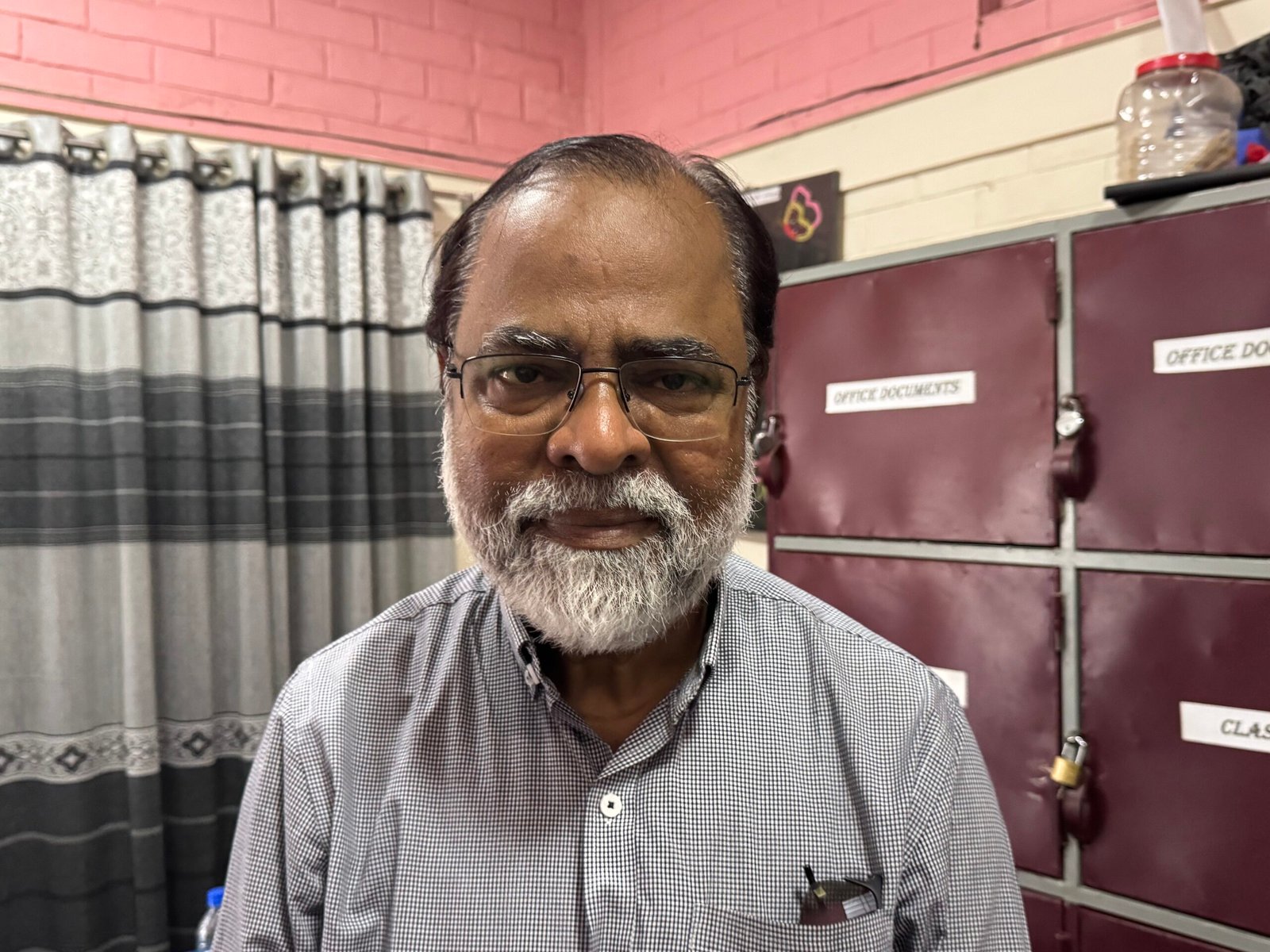
After 52 years, a Pakistani doctor returns to Bangladesh, where his family’s journey from Bihar to East Pakistan and then Karachi reflects the enduring human consequences of the 1947 Partition.
A family history stretching across India, Bangladesh and Pakistan has brought Dr Faiyaz Alam back to the land of his birth, offering a deeply personal perspective on one of South Asia’s most enduring legacies: the displacement, divided identities and unfinished migration stories left behind by the Partition of 1947.
A medical doctor, social development professional, author and humanitarian from Pakistan, Dr Alam returned to Bangladesh in 2026, 52 years after leaving as a seven-year-old child. During his visit he travelled to Saidpur, Rangpur, Chattogram Khulna and Dhaka, meeting Urdu-speaking families and visiting camps and humanitarian projects supported by OBAT Helpers. His wife, Dr Siddiqa Faiyaz, and elder brother, Riaz Alam, accompanied him.
For Dr Alam, the journey was more than a visit to a childhood home. It was a return to a country that remains part of his identity, even after more than five decades in Pakistan.
“I was seven years old when I left Bangladesh for Pakistan. I was born in this country, so I feel a special attachment to it even today,” he said, recalling his emotional connection to the place where his life began. He also has close relatives in Bangladesh, Pakistan and Bihar, India, keeping his family connected across three countries shaped by the upheavals of Partition.
A family history shaped by Partition
The roots of Dr Alam’s family story lie in Gaya, in the Indian state of Bihar. Following the Partition of British India in 1947, his family moved to what was then East Pakistan, settling in Bangladesh’s northern region. In 1974, following the birth of Bangladesh as an independent country in 1971, the family moved to Karachi, Pakistan.
The movement from Bihar to East Pakistan and then to Pakistan illustrates how political borders can change within a single family’s lifetime, turning places of birth, childhood and ancestry into parts of different national histories.
The broader Urdu-speaking Bihari community followed a similar, though far more complex, trajectory. Many Muslims from Bihar and other parts of northern India migrated to East Pakistan after Partition, drawn by the new political geography and their linguistic and cultural ties. After Bangladesh’s independence in 1971, thousands of families found themselves caught between their historical connections to Pakistan and their homes and livelihoods in the newly independent country.
For some, Pakistan remained the preferred destination. Others chose to stay in Bangladesh, while younger generations increasingly came to regard Bangladesh as their homeland.
Dr Alam’s family journey offers a reminder that these choices cannot be understood simply through nationality. Family relationships, memories, language and a sense of belonging often transcend political boundaries.
A community still seeking dignity and opportunity
During his visit, Dr Alam met members of Bangladesh’s Urdu-speaking community living in camps and settlements, including families whose circumstances reflect the continuing socioeconomic challenges faced by many residents.
Speaking about their lives, he observed that many who chose to remain in Bangladesh out of love for the country have managed to build relatively good lives. Others continue to experience significant difficulties but are striving to improve their living conditions.
He also expressed the view that an important positive development is that the government and wider society are not necessarily discriminating against the community in the way some people might expect.
His observations offer a hopeful perspective, while the broader picture remains mixed. Although many Urdu-speaking Bangladeshis have pursued education, employment and social integration, camp residents continue to face overcrowded housing, limited living space, inadequate sanitation, difficulties accessing education and economic insecurity.
In May 2025, Bangladesh’s foreign secretary cited official figures indicating that approximately 324,147 people remained in 79 camps across 14 districts. The report also documented continuing concerns over housing, clean water, education and social insecurity. Figures vary between government sources and community organisations, and there is no single universally accepted current count.
These conditions do not describe every Urdu-speaking family. Many community members live outside the camps, work in different professions and participate in the country’s social and economic life. Nevertheless, the long-standing problems in camp settlements remain a significant humanitarian and development concern.
How many Urdu-speaking people live in Bangladesh?
Estimates commonly place Bangladesh’s Urdu-speaking Bihari population at around 300,000 people, although some community-based figures are higher. An official estimate of about 324,147 people living in camps in 2025, while academic research has also used an approximate figure of 300,000 for the wider community.
The distinction matters: the population of Urdu-speaking Bangladeshis is not necessarily identical to the number of people living in camps or those who identify themselves as awaiting repatriation to Pakistan.
The community’s legal position has also evolved significantly. In a landmark 2008 High Court ruling, the court recognised the citizenship rights of Urdu-speaking people born in Bangladesh and directed that eligible petitioners be included on the electoral roll. Subsequent legal developments reinforced the rights of the community, although access to adequate housing, education and employment has remained uneven.
For many residents, therefore, the central issue today is not simply where their ancestors came from. It is whether they can live with dignity, access public services and secure a better future for their children.
The unfinished chapter of repatriation
The question of returning to Pakistan has remained a defining issue for sections of the community since Bangladesh became independent.
Following the 1971 Liberation War, many Urdu-speaking families sought repatriation to Pakistan. The process began in the 1970s, but it never accommodated everyone who wished to leave.
A 2025 academic study published in Frontiers in Human Dynamics estimates that approximately 178,069 Biharis were officially repatriated to Pakistan, with a further 100,000 reportedly moving through unofficial channels between 1973 and 1993. Other historical accounts give somewhat different totals, reflecting variations in how official and unofficial migration is counted.
The repatriation process subsequently stalled, leaving many families in Bangladesh. Over time, the community itself became divided in its aspirations. Some continued to seek relocation to Pakistan, while others wanted permanent rehabilitation and equal opportunities in Bangladesh, the country where they and their children had built their lives.
This distinction is crucial. It would be inaccurate to assume that all Urdu-speaking Bangladeshis want to move to Pakistan, just as it would be inaccurate to assume that every family has abandoned that aspiration.
For people born and raised in Bangladesh, citizenship, education, employment and secure housing may be more immediate concerns than repatriation. For others, family connections and a historical sense of belonging to Pakistan continue to shape their hopes.
A humanitarian mission beyond borders
Dr Alam’s return also reflects his professional commitment to humanitarian service. A graduate of Sindh Medical College in Karachi, he has spent more than three decades working in healthcare, education, community development and related initiatives. He currently serves as general secretary of Dua Foundation, which supports programmes involving healthcare, clean drinking water, education, poverty alleviation, agriculture and environmental sustainability.
During his Bangladesh visit, he witnessed the work of OBAT Helpers, an organisation engaged in supporting underserved communities through education, humanitarian assistance and development initiatives.
His meetings with camp residents brought him face to face with families navigating difficult living conditions while seeking opportunities for their children. The visit connected his personal history with a broader humanitarian question: how can communities affected by historical displacement move beyond generations of uncertainty towards security and opportunity?
For Dr Alam, the answer lies partly in recognising shared humanity. His family’s story crosses three countries, but its central themes—belonging, family, memory and the search for a better life—are not confined by borders.
Beyond the borders drawn in 1947
Nearly eight decades after Partition, the experiences of families such as Dr Alam’s demonstrate that the consequences of dividing the subcontinent did not end when the borders were established.
One generation migrated from Bihar to East Pakistan. Another grew up in Bangladesh before moving to Karachi. Relatives remained scattered across India, Bangladesh and Pakistan, maintaining connections that political changes could not entirely erase.
Dr Alam’s return after 52 years is therefore more than a personal homecoming. It is a window into the lives of people whose family histories have been shaped by successive changes in sovereignty, identity and national belonging.
His account offers a measure of optimism about the Urdu-speaking community’s capacity to build lives in Bangladesh. Yet the continuing challenges faced by many camp residents underline the need for sustained investment in housing, education, healthcare, employment and community development.
The lesson of this family’s journey is not that identity must belong to one country alone. It is that people can maintain meaningful ties to several countries while seeking dignity and security wherever they live.
For the Urdu-speaking community of Bangladesh, the lasting promise of Partition’s unfinished story should be a future in which neither ancestry nor language limits a person’s opportunities—and in which every family can choose its future without sacrificing its past.
