



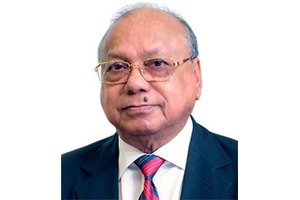
Nasiruddin Chowdhury
Lion Shri Rupam Kishore Barua is a Visionary Industrialist who has introduced new industries to enhance investment and employment generation to boost up national economy and, on the other hand, is always looking
forward to serving humanity through different welfare activities. His innovative talent is enhancing industrialization and investment in the country, while this welfare-oriented human being begets embodiment of an eminent personality.
Rupam Kishore Barua has the credit of launching the first ever cement industry in private sector in the country, and owing to this credit he can be called the pioneer of cement industry in the private sector in Bangladesh. Even though he is an outspoken person in conversation, he is somehow different, detached and apathetic in expressing himself. He is the one who is entitled as the pioneer of the cement industry in the private sector, yet even after 42 years (1984-2026) of the introduction of the said industry in 1984, he did not claim credit. This is where Rupam Babu’s greatness lies and his difference from the average Bengalees.
In fact, Rupam Kishore Barua is a different kind of person; some glimpses of his breed are evident from the following examples. The sapling he planted 42 years ago has now become a giant tree. He founded Confidence Cement Limited along with a few other entrepreneurs. Over time, many more industries named after “Confidence” in partnership with others originated from Confidence Cement, such as, Confidence Power Limited, Confidence Infrastructure, Confidence Steel Limited, Confidence Electric Limited etc. Two more industries originated from the Confidence Group – namely Electropac Industries Limited, Asian Paints and New Horizon Computer Education Center. Asian Paints is one of the largest paint manufacturers in Asia.
The main identity of Shri Rupam Kishore Barua is that he is a prominent industrialist. Then the identity that is considered important these days, is that he is a Lion. Lionism is one of the largest global welfare organizations. But as he grew up, those identities have been buried into oblivion. For example, he was involved in student politics in the decade of Sixties of the last century during his student life. He had contributions to the 1971 Freedom Struggle of
Bangladesh as well. He is involved in many auspicious works and is engaged in relentless efforts to build a liberal, moral and social environment. He is a heroic freedom fighter. Not only Rupam Kishore, but three members of his family participated in the Liberation War of 1971. Perhaps, there are not many families in the country where three members of the family went to sacrifice their lives in the freedom struggle of the motherland.
The vivid picture of the situation during the Liberation War has been sketched nicely in Bangladesh Documents in two volumes published by the Government of Bangladesh. In Volume-One Sheelendra Kumar Singh said, The Bangladesh Documents, in two volumes, presents a print version of the genesis of Bangladesh crisis leading up to a War of Liberation for the people of Bangladesh and the world reaction to their tribulation. These documents depict the story of the emergence of the People’s Republic of Bangladesh from an exploited province to freedom and sovereignty – the establishment in Dhaka of a duly constituted national government and the beginning of a new era of national reconstruction. The first volume tells the story of the progress of the Bangladesh crisis up to August 31, 1971. The second volume begins from September 1, 1971 and covers events up to March 1972. The documents are a valuable addition to the published literature on Bangladesh’s freedom struggle and hence are of great archival value. The documents would serve as sources of information on Bangladesh War of Liberation for researchers and scholars.
As Mr. Rupam Kishore Barua stated in “The Battered Buddhists” in Volume-One of the Bangladesh Documents, “I was an M.A. examinee in Economics in Chittagong University. Driven and charged by the atrocities and inhuman Pakistani forces I along with many other Buddhists residing in village Mohamuni under police station Raozan in the district of Chittagong in Bangladesh had to take shelter in Tripura state in India. On the last Baishakhi Purnima Day, the armed Pakistani troops followed by local looters and antisocial elements entered into our village Mohamuni. The Pakistani troops robbed people of their wrist watches, ornaments, cash and all valuables, and
prepared a list of government servants and assaulted them, raped some women of the village on the spot and carried away some others.
The Muslim Leaguers led by the son of Mr. Fazlul Quader Chowdhury, a Convention Muslim League member, who had suffered an ignoble defeat in the last election, did the looting. Zahur, Yusuf, Yunus and Mohmamad Ali are some of those who also did the looting.
Two or three days thereafter, people of several villages predominantly Buddhists numbering 300 to 400 started for India but at a place called Dhaishya Babar Khamar and at Ranirhat the Pakistani troops attacked them and shot dead some of them while the looters looted all their belongings. After this attack, when I along with some others had fled to the hills, did no more proceed along that route. In high risk I returned to Chittagong town only to find that the Hazari Golly, Nabagraha Bari, Awami League office and the houses of the Awami Leaguers, all the houses and shops on either sides of the Chittagong-Dhaka Grand Trunk Road had been reduced to ashes and the entire villages at Mirsharai and Sitakund had been completely burnt. These are only a few of the barbarities and atrocities committed by the Pakistani troops.”
A life, full of so many successes, faced a tragic and painful accident that took away all the joys and excitements from his life. On 24 November 1990, a gloomy darkness descended on his life. What an infinite grace of God! On that day, when the body of 18 years old Aniruddha Barua, son of Rupam Kishore and Suprabha Barua, was torn to pieces and lying on the road in a tragic road accident, it was as if the heart of the Rupam couple was torn. On that day, another Rupam Kishore emerged. He became the compassionate Rupam Kishore Barua. As God has taken away the darling He had gifted him, Rupam Kishore formed the Aniruddha Barua Memorial Trust after the name of his beloved lost son. It impelled him to take an oath to serve the humanity. He has dedicated himself to the relief and welfare of the suffering, affected, sorrowful and endangered people. He is trying to find his lost son among the
down-troden. He is the Chairman-sponsor of the Aniruddha Barua Memorial Trust. His annual donation to this trust is over Taka 14 lakhs.
Major Projects in Memory of Aniruddha Barua (his late son) are :
1. Aniruddha Barua Memorial Temple at Mohamuni village entrance. 2. Aniruddha Barua Memorial Library. 3. Aniruddha Barua Memorial Computer Center. 4. Aniruddha Barua Memorial Children’s Park. 5. dining hall for monks at Mahananda Sangharaj Monastery; 6. Aniruddha Memorial Archway in Mohamuni Temple; 7. Emergency Eye Operation Theater at Lions Eye Hospital Chattogram; 8. Ani Mukta Mancha a 3-store rehearsal hall at Shilpakala Academy (Govt. organization); 9. A storey-2 building and pure water facility at Imam Gazzali University College; 10. annual scholarships for ten schools of Raozan that hold the 1st, 2nd & 3rd positions in the annual Exam since 2002 on International Mother Language Day (21st February); 11. Executive Member, BNSB Eye Hospital at Chattogram. 12. annual free eye check-up and health service at Mohamuni village on 21st February with support from Lions Eye Hospital; 13. distribution of new school uniform to 120 orphans annually on 1st January (school dress) & new dress on Pohela Baishakh; 14. distribution of new clothes to underprivileged families on Pahela Baishakh every year and winter clothes to 500 families at Mohamuni Pahartali; 15. Sponsorship of Inter-School Table Tennis and Under-16 Football tournament by CJKS since 2002; 16. annual health service on Aniruddha’s death anniversary (24th November); 17. food and clothes distribution to orphans and widows on Aniruddha’s birthday (August 15); 18. construction of a new school building named after Advocate Phani Bhushan Barua at Mohamuni Anglo Pali School; 19; installation of pure drinking water facilities at Mohamuni Anglo Pali School; 20. establishment of Phani-Toti Mancha at Mohamuni Anglo Pali School; 21. monthly donation, food and school uniform for orphans and widows at Mohamuni village; 22. construction of the Phani-Toti Mancha at Mohamuni village, at the back of Mohamuni Mandir. Raozan, Chattogram; 23. construction of Totini Barua Community Center at Mohamuni Temple area; 24. foundation and funding for Mohamuni Cultural Association office building at Mohamuni; 25. Rest
house for cremation attendees; 26. residence for monks and a new building in Mohamuni Mahananda Monastery; 27. donation of 14 decimals of land to Ward No. 9 Pahartali Union Council Office; 28. annual Iftar materials for underprivileged people at Pahartali village; 29. Science Lab construction and full equipment donation to Raozan Degree College; 30. Science Lab construction and donation to Kadalpur High School; 31. Science Lab and boundary wall construction at Unsatturpara High School; 32. Boundary wall, three-storey building, toilets, and arch construction at Uttara Nabatara Primary School; 33. annual badminton tournament in memory of late Pranab Kumar Barua (elder brother) organized by Mohamuni Tarun Sangha the for last 40 years. 34. modernization of Halima Rokeya Hall of Chittagong Lions Foundation at the cost of Taka 1.1 million; 35. currently funding a five-storey Mother and Child Hospital at Mohamuni Pahartali village with 70 beds and all-age patients health services; 36. Chief patron of Bangladesh Buddhist Youth Council; 37. Chief patron of Anoma Cultural Council, among others.
For his involvement in business and Lions welfare services, he has traveled extensively to the USA, UK, Germany, France, Norway, Spain, Italy, the Netherlands, Belgium, China, Japan, Singapore, Hong Kong, South Korea, Taiwan, Thailand, Malaysia, Indonesia, Kuwait, India, Pakistan, Australia, Nepal, Myanmar, Lebanon, Bahrain, Keneya, Sri Lanka, UAE, Bhutan, Egypt, South Africa, Turkey, Vietnam, Maldives, Addis Ababa (Ethiopia) etc.
For his contribution to social and cultural works, Lion Rupam Kishore Barua received the United Nations Award in 2002 and the title “Dharmadoot” from India’s International Brotherhood. He was also titled “Bijoy Ratna” by the US Sangha (monk community). It is noteworthy that many religious and social institutions in Bangladesh have flourished owing to his significant financial contributions.
Kadal Khan Gazi, the commander of Fakhruddin Mubarak Shah (1338-1349), ruler of Sonargaon who conquered Chittagong in 1340 AD or one of the Baro
(12) Aulias, was buried at Kadalpur or he stayed in this area of Raozan for a short period in the 14th century, and the area took his name from that time and became Kadalpur. At that time, Kadalpur was extended up to Pahartali Mohamuni. Till then, Mohamuni was not named. Pahartali Mohamuni was known as Kadalpur. In 1580 AD, after the Arakan Raj captured Chittagong and the Magh kingdom was established, the Maghs came and settled in various places. The Maghs might have settled in Pahartali as well. Buddhist social reformer Chainga Thakur went to Arakan on a pilgrimage. Chianga Thakur was fascinated by the Buddha statue called ‘Mahamuni’ in the Mihang and Royal Temples of Arakan and, intending to establish a similar Buddha statue in his homeland, he drew up a portrait of the statue on paper and brought it back to his homeland. He called the villagers to a meeting and told them that he had seen a wonderful and holy Buddha statue in Arakan and expressed his desire to establish a similar Buddha statue in Pahartali. The villagers, being aware of his desire, responded to it and after collective donations, brought an artist from Akyab and established a Buddha statue similar to ‘Mahamuni’ in Pahartali village at 1813 AD. At the time of establishing the Mohamuni Vigraha Temple, a poem about Chainga Thakur was heard being recited by the people:
“Short-statured Chainga Thakur Has so much wisdom.
The great sage of Mohamuni He brought it to Kadalpur.”
Then Pahartali was separated from Kadalpur and named as Mohamuni. Rupam Babu was born in this historically famous village. A year before his birth, the geography of Bengal, as a matter of fact, the geography of India changed. In August 1947, the whole of India was divided as per Radcliffe’s communal share, and on August 14, India was divided into two separate states. Pakistan was declared independent on August 14 and India on August
- Rupam Babu’s birthplace Raozan fell in the eastern part of Pakistan state.
Rupam Babu’s family originated from an ancient aristocratic house, the Phul Tanchangya dynasty. At the end of the Phul Tanchangya dynasty, a name called Ananga Mohan [Keyang Chowdhury) is found. He had the family title of Mutsuddi. From this name we find the great-grandfather of Rupam Kishore Barua. Ananga Mohan was his great grandfather, His two sons were Kamol Chandra Barua (Kamol Takur) and Satish Chandra Barua Moktar.
Satish Chandra Barua Moktar was Rupam Babu’s grandfather. He had three sons and two daughters. Satish Chandra Barua became a legend by displaying extraordinary skills and achievements in the profession of a Moktar. The court and administrative offices had not yet been shifted to Parir Pahar from the Madrasa Hill (Mohshenia Madrasa or Buda Madrasa to Islamic Intermediate College, Normal School and finally, the present Haji Mohammed Mohsin College Hill). Parir Pahar, which is now called Court Building, was built in 1893. Satish Chandra Barua was older than that. Kolkata and Chittagong were in one country at that time; Kolkata was the capital of undivided India. Moktar Saheb practiced law suit in Kolkata and obtained reputation in the field. His first son was Jamini Ranjan Barua, BA, an Agricultural and Cooperative Officer under the British Government. Moktar’s second son — Rupam Kishore Barua’s father — Advocate Phani Bhusan Barua, BA, BL, Calcutta University, was former MLA (Member of Legislative Assembly) of the Pakistan Constituent Assembly and Provincial Legislative Assembly. He was also the former president of the All Pakistan Buddhists Association and former general secretary of the Chittagong Bar Assertion. Moktar’s third son Indu Bhusan Barua, BA, BT, London was a retired headmaster of Comilla Zilla School. Two daughters of Satish Chandra Barua Moktar were: Yogamaya Barua, 1st daughter and Urmi Barua, 2nd daughter.
Pahartali Mohamuni is such an enlightened village where the man like Dr. Beni Madhab Barua was born. He obtained the first D.Lit Degree from Mohamuni that made him known throughout Asia. Therefore, the glory that
Chaing Thakur had brought the Mohamuni statue from Burma and gave the name ‘Mohamuni’ to the past Kadalpur village is not a myth.
Lion Rupam Kishore Barua was born on June 4, 1948, in a respected Buddhist family in the traditional Buddhist villa of Mohamuni Pahartali under Raozan Police Station.Chattogram. His father, late Advocate Phani Bhushan Barua BA;BL, was a Member of the Legislative Assembly (MLA) of the then Pakistan National Assembly, President of the Pakistan Buddhist Association, Commissioner of Chittagong Municipality, Secretary General of the Chittagong Bar Association, and Visitor of Chittagong Jail. His mother was the late Totini Barua, housewife.
Rupam Kishore Barua completed his SSC (Secondary School Certificate) from Chittagong Collegiate School in 1964 and Bachelor’s degree from Chittagong College in 1968 under Chittagong University. He actively participated in the Bangladesh Liberation War in 1971. After independence, he began his professional career at Atlas Shipping Company in 1972. He joined Maritime Agency Ltd as General Manager in 1980. He founded Confidence Shipping Lines in 1984. In 1991, in assertion on with other entrepreneurs, he established Confidence Cement Limited, the first private-sector cement manufacturing industry in Chattogram, Bangladesh.
On March 25, 1971, the barbaric Pakistan army attacked the freedom-loving Bangalees with cannons, tanks, recoilless rifles, machine guns and bulldozers and started cornering women, children, young and old. They engaged in the most barbaric and horrific massacre in human history. They started ablazing and demonic destruction in the Dhaka University hostels, Peelkhana EPR (East Pakistan Rifles) base and Rajarbagh Police Lines. The bulldozers crushed the Dhaka University teacher, philosopher Dr. G.C. Dev and Jyotirmoy Guha Thakurta under wheels. The followers of traditional minority religions at Shankhari Bazar in Dhaka were mostly killed, destroyed, raped and looted. In Chittagong too, the invading forces carried out wholesale massacres in the Hindu minority villages, looted houses and burned them to
ashes with gun powder. Those who were able to defend themselves from this killing and destruction left their forefathers’ homesteads and migrated to the neighboring India. Meanwhile, when Bangabandhu Sheikh Mujib declared independence of Bangladesh on March 26, and called on the agitating Bengali nationals for independence, to join the liberation war to oust the occupying forces from their homeland, war broke out all over Bangladesh. Rupam Kishore Barua, being involved in student politics, was aware of the upcoming situation and, witnessing the massacre of the invading forces, was inflamed with a desire for revenge and went to India for military training to join the Liberation War. When the Pakistani occupying forces surrendered on 16 December 1971, an independent sovereign Bangladesh emerged. Rupam Babu, who had turned from the liberation war, also rejoiced in the joy of victory.
Beyond his professional life, Lion Rupam Kishore Barua is deeply involved in social, humanitarian and cultural activities. He was the District Governor of the International Lions Club, District 315-B4 Bangladesh in 2001-2002 A that time, he was recognized as the Best Governor among multiple districts and received a medal from the then Honorable Prime Minister. He was the first among Buddhists in the Indo-Pak subcontinent to become a District Governor of Lions Club International. For his humanitarian services, he received several awards including the International Lions Club President’s Award.
He is a lifetime member of many organizations including Chittagong Karnaphuli Lions Club, Bangladesh Lions Foundation, Dhaka and Chattogram, Lions Blood Bank, Dhaka & Chattogram, Chattogram Mother and Child Hospital, Red Crescent Society Bangladesh, Chittagong Diabetic Association, Bangladesh Family Planning Association, Bangladesh TB Association, Chittagong Film Society, Child Leukemia Association, Chittagong Cancer Foundation, Abuliya Lions Charitable Hospital, Pragyalok-Jinabansha Memorial Trust, Raozan Club, Chittagong Press Club, Chittagong Officers Club and Chittagong Institute (Senior Club). He is also Member of Chittagong Club and Chittagong Boat Club.
He is a Vice President of Chittagong Udichi, Chittagong Club, and Chittagong Boat Club. He is also the General Secretary of the Chittagong College Alumni Forum (Sixties), an Honorary Member of the Chittagong Collegiate School Alumni Association, and a Lifetime member of the International Meditation Center and Buddhist Conversion Assembly in Buddha Gaya, India.
He was Chairman of the Managing Committee of Mohamuni Anglo Pali High School (2008-2024), a patron of the Bangladesh Rabindra Parishad and Bangladesh Nazrul Parishad and former Chairman of Imam Gazzali University College Managing Committee (2008-2024). He is also Vice President of Prantik Welfare Trust and Chairman of the Project Implementation Committee for Mohamuni Temple Development and Preservation Committee. Mr. Barua is the Sponsoring Chairman of the ‘Aniruddha Barua (ANI) Memorial Trust’, donating over BDT 1.4 million annually. He is the Founder Chairman of Rupam Kishore Suprova Barua Trust. He is also Founder Chairman of Beni Madhab-Phani Bhusan memorial lecture and Founder Chairman of Phani Bhusan Totini Barua Samaj Kalyan Trust. He is also a sponsor and lifetime Chairman of numerous charitable funds and institutions including Advocate Phani Bhushan Barua Jyotipal Mahathero Scholarship Fund, Beni Madhab-Phani Bhushan Barua Memorial, Mohamuni Widows and Orphans Welfare Center and Ukhiya Ananda Bhavan Bihar Orphanage. He donated 10 million Taka to Child Hospital and Cancer Institute in Chattogram.
Ctg-Agartala Journalists view exchange
An 11-member delegation of Agartala Press Club headed by its General Secretary Jayanta Bhattacharjee visited Chittagong Press Club on 22 May 2003. They exchanged views with the local journalists on different issues for enhancement of commercial and cultural relations between the two neighbouring cities. The journalists arrived Chittagong at the invitation of Confidence Cement Limited on the occasion of exporting cement to Agartala on 21 May. Recalling the role of the people of Agartala during the Liberation Struggle of Bangladesh leaders of Chittagong Press Club said that the bond of friendship would be further strengthened in the days to come. President of Chittagong Press Club Abu Sufian presided over the meeting. Jayanta Bhattacharjee, Buddha Gupta, Shuvasis Kar Bhaumik, Sujit Dey, Suprabhat
Debanath, Parthajit Dutta, Pranab Chakrabarti of Agartala Press Club and Mostaq Ahmed, Kalim Sarwar, Shahidul Alam, Ataul Hakim, Saber A Asgari, Iskandar Ali Chowdhury, Pankaj Kumar Dastider, Asif Siraj, Sirajul Karim Manik of Chittagong Press Club addressed the meeting.
After independence, he started his professional career with Atlas Shipping Company. Then in 1980, he joined Maritime Agency Limited and was promoted to the position of General Manager of that company. Rupam Barua started Confidence Shipping Lines Company in 1984 and in 1992, along with some other entrepreneurs, he established the Confidence Cement Limited, the first cement company in the private sector in the country. Currently, he is the Vice Chairman of Confidence Cement Limited, Confidence Power Limited, Confidence Infrastructure Limited, Confidence Steel Limited and Electropac Industries Limited, Confidence Electric Limited and M/s Asian Paints, the largest paint manufacturing company in Asia, and the Director of New Horizon Computer Education Center.
The gentle humanistic teachings of Buddhism : friendship, love and compassion flowing in Rupam Babu’s blood, make his life bright and glorious with human consciousness. As a result, he became a Humanist and Philanthropist. He provides charity, donations, but his secret charity area is far greater. He is not unaware of the charity of India’s Ratan Tata, Azim Premji, America’s Bill Gates, Warren Buffett, or the legendary Hatem Tai, Haji Mohsin or the 19th century philanthropists of Chittagong —Chand Meah Saudagar, Khan Bahadur Abdul Hakim Meah, Islam Khan and the like.
The desire for human welfare led Rupam Babu to the liberal humanitarian world of Lionism.
Rupam Barua is the eldest among 10 brothers and three sisters. The brothers are: 1. late Pranab Kumar Barua, B.A., Customs Officer; 2. late Engineer Prashanta Kumar Barua, B.Sc.; 3. late Prodyut Kumar Barua (immature death); 4. Freedom Fighter Pranodit Kumar Barua (Bhadanta Sumangal Bhikkhu); 5. deceased Pratish Kumar Barua, B.A., businessman; 6. deceased
Piyush Kumar Barua, SSC, businessman; 7. deceased Pramotosh Kumar Barua, Diploma Engineer; 8. Freedom Fighter Industrialist Rupam Kishore Barua; 9. deceased Freedom Fighter Partha Pratim Barua and 10. Prasun Kumar Barua, B.A., businessman.
The sisters are : 1. deceased teacher Ajita Barua, M.A., 2. Namita Barua, B.A., house wife, expatriate in America and 3. Anamika Barua, B.A. housewife.
For his social and cultural activities Lion Rupam Kishore Barua was awarded the United Nations Prize 2002 and the Honour “Dharmadoot” by the International Brotherhood of India. He was awarded the Honour “Vijoy Ratna” by the USA Bhikshu Sangha. It needs to be mentioned that many religious and social institutions in Bangladesh have got a golden opportunity due to the significant financial donations of Lion Rupam Kishore Barua. In his personal life, Lion Rupam Kishore Barua is a very friendly, easy-going and humble person who is respected and admired by everyone.
Shri Rupam Kishore Barua’s wife, Lion Suprava Barua, obtained a bachelor’s degree with Honours is English Language and Literature from the Chittagong University. Later, she obtained the B.Ed degree. Their only daughter Ananya Barua, obtained an M.A. degree in Industrial Management and Entrepreneurship from Birmingham Aston University, London. His son-in-law obtained a degree in Computer Engineering from Birmingham Aston University, London. As mentioned earlier, his only son, Aniruddha Barua, unfortunately died prematurely in a road accident on November 24, 1999, at the age of just 18 years.
