



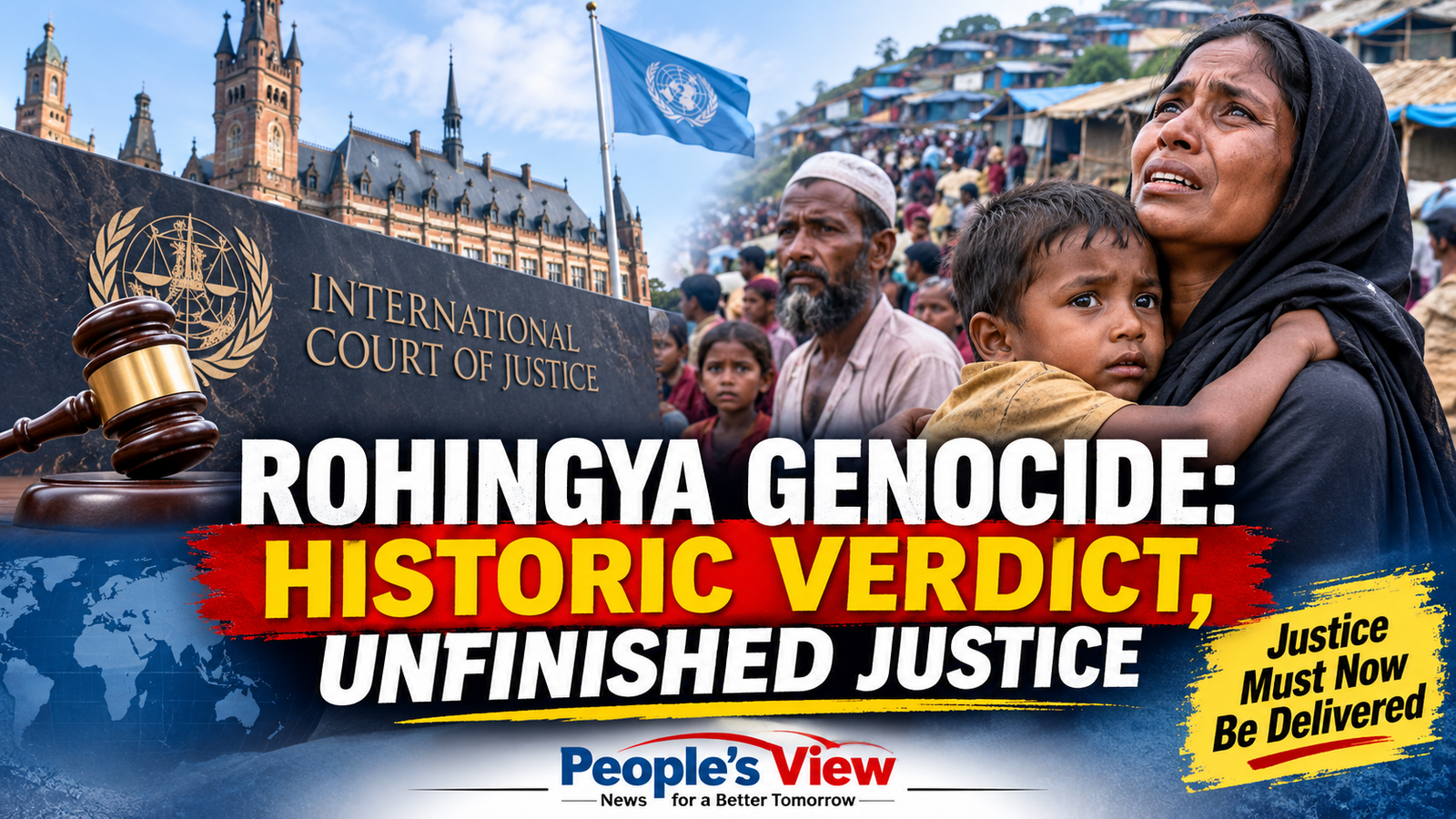
ICJ Recognises Rohingya Genocide: Now Comes the Real Test of Justice, Accountability and Repatriation
Khalilur Rahman’s camp visit sends a powerful political message, but translating a historic legal victory into the safe return of more than one million refugees remains an enormous challenge
For nearly a decade, the Rohingya have waited for the international community to acknowledge what they experienced in Myanmar: mass killings, systematic sexual violence, destruction of villages and the forced displacement of an entire community.
On November 19, that recognition finally came from the world’s highest court.
In a landmark judgment, the International Court of Justice (ICJ) ruled that Myanmar committed genocide against the Rohingya in northern Rakhine State during its 2017 military clearance operations. The ruling represents an extraordinary victory for the Rohingya people, whose struggle for recognition and justice has continued across generations.
But the historic legal victory has immediately raised a more difficult question: **Will the international community now deliver justice, or will the Rohingya once again become victims of diplomatic promises and political calculations?**
The significance of the judgment was reflected in Bangladesh the following morning, when United Nations General Assembly President and Bangladesh Foreign Minister Dr Khalilur Rahman visited Rohingya refugee camps in Ukhiya, Cox’s Bazar.
Addressing refugees at Camp No. 4 on November 20, Khalilur described the verdict as a historic moment, telling the gathering that the highest court of the United Nations had finally spoken their name.
“The highest court of the United Nations spoke. It spoke your name. Rohingya. Yes, Rohingya. Its decision was clear: what was done to you in 2017 was genocide,” he said.
His visit was more than a humanitarian gesture. It carried considerable diplomatic and political significance, particularly because he was addressing the victims at a moment when their decades-long struggle had received unprecedented international legal recognition.
A historic judgment, but not the end of the struggle
The ICJ judgment in the case brought by The Gambia, with the support of the Organisation of Islamic Cooperation (OIC), is a defining moment in international accountability.
The court found Myanmar responsible for genocide and also established violations of its obligations to prevent genocide, punish those responsible and preserve evidence.
The judges ordered Myanmar to take immediate steps to investigate suspected perpetrators and prosecute them where warranted, ensure that similar crimes do not recur, provide restitution and compensation, and facilitate the safe, voluntary and dignified return of displaced Rohingya.
The court also directed Myanmar to submit a report within two years detailing its restitution measures and proposed compensation arrangements.
Importantly, the judgment is final and binding.
For the Rohingya, this is a fundamental change in the international legal landscape. Their suffering is no longer simply a matter of competing political narratives or allegations. The court has established state responsibility for genocide.
However, a legal judgment and its implementation are two different realities.
The ICJ does not have its own enforcement mechanism. Under Article 94 of the UN Charter, non-compliance can be brought before the Security Council, where geopolitical rivalries and the veto powers of permanent members could complicate meaningful action.
Myanmar’s military-backed authorities have already rejected the ruling as unfair, pointing to the nine-to-six vote among the judges.
T
his response suggests that international pressure, rather than voluntary cooperation from Myanmar, will be essential to implementing the judgment.
Khalilur’s visit: From diplomatic recognition to political responsibility
Khalilur Rahman’s presence in the camps immediately after the verdict carries particular significance.
Having previously served as Bangladesh’s High Representative for Rohingya Affairs, he is familiar with the humanitarian and diplomatic complexities of the crisis. His decision to meet refugees in person, rather than simply issue a statement from New York or Dhaka, offered an important symbolic connection between international diplomacy and the people directly affected.
His message was clear: the ICJ verdict must become the beginning of a journey towards justice, not its conclusion.
He outlined four broad priorities: accountability for genocide, safe and dignified repatriation, reparations and stronger humanitarian assistance, and implementation of the judgment with guarantees against future atrocities.
These priorities reflect the central demands of the Rohingya community.
Yet his dual position as Bangladesh’s Foreign Minister and President of the 81st UN General Assembly creates an opportunity as well as a responsibility.
Bangladesh now has an unusual diplomatic platform to mobilise international support, encourage cooperation among UN member states and maintain the Rohingya issue at the centre of global discussions.
The challenge is to convert that diplomatic influence into concrete outcomes.
Repatriation remains the biggest test
For the more than one million Rohingya living in Bangladesh, the ultimate objective is not simply international recognition of past atrocities. It is the restoration of their right to live safely and with dignity in their ancestral homeland.
Years of repatriation initiatives have failed. Myanmar’s political instability, the military coup of February 2021 and the subsequent civil war have fundamentally changed the situation in Rakhine State.
The Arakan Army has gained control over much of the territory where Rohingya refugees would potentially return. Meanwhile, Rohingya communities remaining inside Myanmar continue to face serious insecurity, restrictions and displacement.
This creates a complicated political reality.
Bangladesh must negotiate not only with Myanmar’s military-backed authorities but also confront the emerging reality of territorial control in Rakhine State.
A return arrangement based solely on agreements with the central authorities, without security guarantees and cooperation from those exercising effective control on the ground, would risk becoming another failed initiative.
The ICJ judgment strengthens the legal basis for demanding repatriation. But it cannot independently establish peace, security or political reconciliation in Rakhine State.
For repatriation to become realistic, citizenship rights, freedom of movement, protection from discrimination, restoration of homes and property, and international monitoring must be guaranteed.
Anything less would risk sending refugees back into another cycle of persecution.
Bangladesh cannot carry the burden indefinitely
The verdict also comes at a critical time for Bangladesh.
Hosting more than one million Rohingya has placed enormous pressure on the country’s economy, environment, public services and local communities, particularly in Cox’s Bazar.
Humanitarian funding has declined, while food security, education, healthcare and protection remain major concerns.
The 2026 humanitarian appeal of approximately $710 million has received only around 69 per cent of the required funding, according to figures cited by Reuters.
The international community cannot celebrate the ICJ judgment while simultaneously allowing humanitarian support for its victims to deteriorate.
The responsibility for resolving the crisis must not remain concentrated on Bangladesh.
The countries that supported the genocide case, international financial institutions, UN agencies and major donor governments must develop a coordinated framework linking humanitarian assistance, accountability, reparations and sustainable repatriation.
Reparations are particularly important. Compensation must recognise not only individual losses but also the collective destruction of communities, livelihoods, cultural identity and property.
The responsibility for these reparations rests with Myanmar under the court’s judgment.
The geopolitical obstacle to justice
Perhaps the greatest uncertainty lies in international politics.
Myanmar’s military authorities have historically benefited from geopolitical divisions, particularly the strategic interests of regional and global powers.
China’s position will be particularly important because of its influence over Myanmar and its permanent membership of the UN Security Council. Russia’s position could also affect any attempt to secure stronger enforcement measures.
International reactions to the verdict have already revealed divisions. While the European Union and several Western governments welcomed the judgment, China expressed concerns about what it described as judicial overreach.
The question is whether international powers will prioritise the principles of international law or continue to calculate their responses through strategic interests.
The ICJ has delivered its legal verdict. The political responsibility now belongs to the international community.
A new opportunity for Bangladesh’s diplomacy
For Bangladesh, the judgment creates a rare opportunity to reposition the Rohingya crisis from a prolonged humanitarian emergency to an international accountability and political resolution agenda.
Khalilur Rahman’s presidency of the UN General Assembly could provide an important platform for building a broader coalition around implementation of the judgment.
Bangladesh should pursue a structured diplomatic roadmap with measurable objectives: international monitoring of Myanmar’s compliance, accountability for perpetrators, a credible reparations mechanism, stronger humanitarian financing and internationally guaranteed conditions for repatriation.
The country should also ensure that Rohingya representatives participate meaningfully in discussions about their future. Decisions about their return cannot be made without the participation of the people whose lives are at stake.
The international community must also address the future of Rohingya children, many of whom have spent most or all of their lives in refugee camps. Without education, skills, legal identity and meaningful opportunities, an entire generation risks growing up without a secure future.
The verdict must not become another unfulfilled promise
Khalilur Rahman’s visit to the camps on November 20 brought a powerful message to a community that has experienced decades of persecution and displacement: the world has finally heard them.
But the real measure of this historic moment will not be the celebrations inside the camps, the diplomatic statements issued by governments or the international headlines generated by the ICJ judgment.
It will be whether those responsible are held accountable, whether the Rohingya receive compensation for their losses, whether their rights and identity are recognised, and whether they can eventually return to Myanmar without fear.
The ICJ has established a historic legal precedent by holding a state responsible for genocide against the Rohingya. The challenge now is to ensure that this precedent produces real consequences.
For Bangladesh, the responsibility is to sustain international pressure and turn diplomatic momentum into a practical solution.
For the United Nations, it is a test of whether its principles can prevail over geopolitical interests.
And for Myanmar, the verdict presents an unmistakable obligation to confront the crimes committed against the Rohingya.
**The world has recognised the genocide. Now it must prove that justice is more than a judgment written in The Hague.**
