



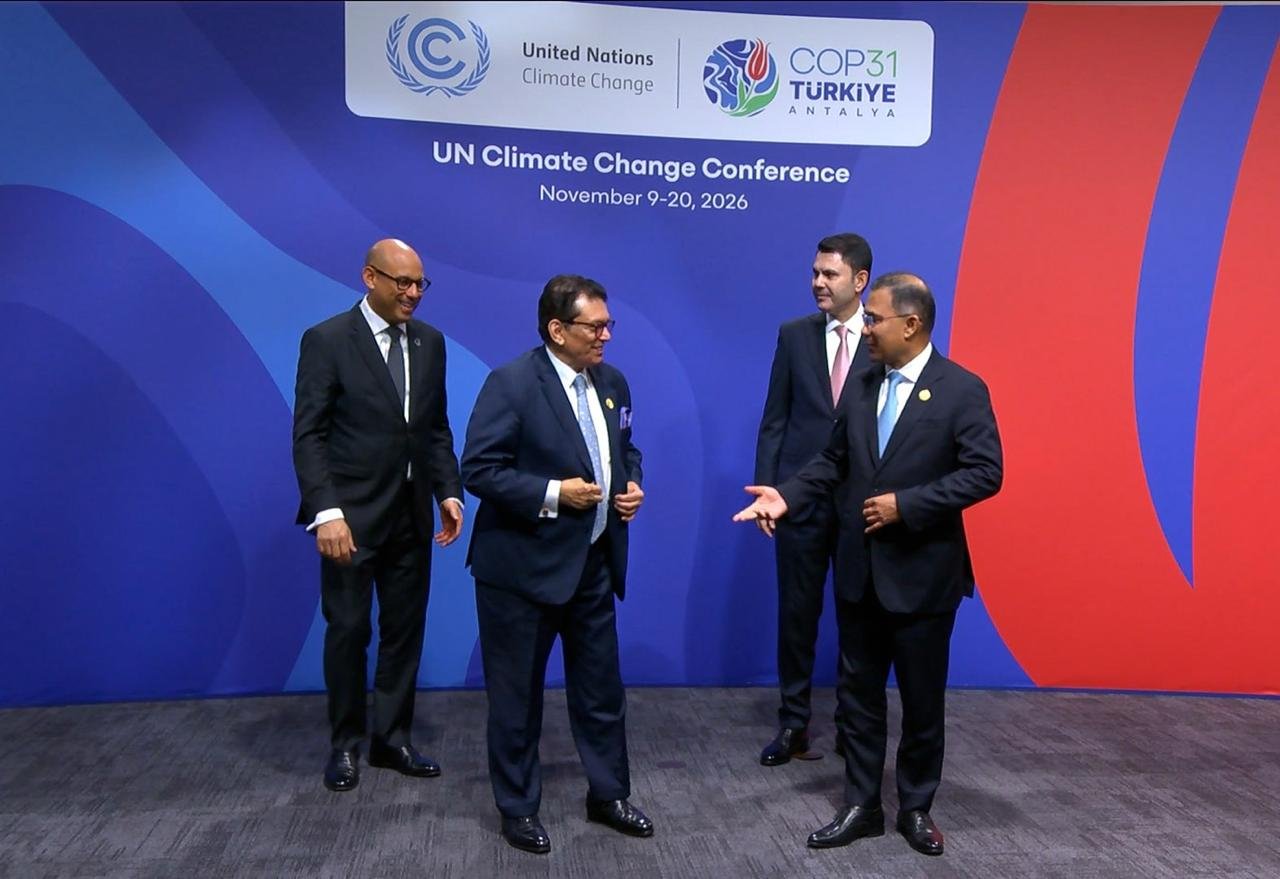
Bangladesh has arrived at COP31 with a compelling argument: a country contributing very little to global greenhouse gas emissions should not be forced to bear the disproportionate economic and human costs of a climate crisis it did little to create.
In Antalya, Bangladesh is seeking to translate that argument into diplomatic pressure, international financial commitments, technology partnerships and recognition of its adaptation challenges. Its message is clear: climate finance must come primarily through grants rather than loans, developed countries must honour their historical responsibilities, and vulnerable countries need greater access to resources to address adaptation and loss and damage.
However, an important question remains: Is Bangladesh making the most of its presence at COP31, particularly through its national pavilion?
The initial performance presents both encouraging developments and missed opportunities.
A strong diplomatic agenda, but results remain the real test
Bangladesh’s preparations for COP31 identified several priorities: grant-based climate finance, adaptation, loss and damage, renewable energy, technology transfer, climate-resilient development and implementation of its National Adaptation Plan.
Environment, Forest and Climate Change Minister Abdul Awal Mintoo outlined these priorities before the conference, emphasising the need to simplify access to international climate funds and ensure that vulnerable communities receive meaningful support.
Bangladesh is also seeking a threefold increase in adaptation funding and stronger mechanisms to address economic and non-economic losses, including displacement and the destruction of livelihoods.
The country’s National Adaptation Plan (2023–2050) carries an estimated financing requirement of $230 billion. This figure alone demonstrates the enormous gap between Bangladesh’s climate ambitions and its available financial resources.
Bangladesh has also highlighted an estimated $15.2 billion in annual economic losses associated with climate impacts, strengthening its argument for an adequately funded global Loss and Damage mechanism.
These are important negotiating positions. But articulating demands is only the beginning of climate diplomacy. Bangladesh’s success will ultimately depend on whether these demands generate stronger political commitments, accessible funding and practical cooperation.
Bangladesh Pavilion: A diplomatic platform or a missed opportunity?
The Bangladesh Pavilion is one of the country’s most important platforms at COP31.
Ahead of the summit, the government planned to use its approximately 100-square-metre pavilion in the Blue Zone to present the country’s climate vulnerability, adaptation experience, NDC 3.0, National Adaptation Plan, renewable energy initiatives, carbon markets, nature-based solutions and community-led climate action.
The pavilion has the potential to serve three important purposes:
- Present Bangladesh’s climate challenges directly to international policymakers and development partners.
- Showcase successful local adaptation models and innovative solutions.
- Build partnerships with international climate funds, investors, research institutions and technology providers.
But a national pavilion should be more than an exhibition space or a venue for official speeches.
Its success should be measured by the quality of discussions, international participation, media engagement, partnerships developed and concrete commitments emerging from its activities.
Bangladesh must demonstrate not only how vulnerable it is but also how effectively it can use international resources to protect people, infrastructure, livelihoods and economic development.
This is where the pavilion’s performance deserves closer scrutiny.
The Jute Pavilion: A promising example of climate and economic diplomacy
One encouraging development is Bangladesh’s effort to connect climate action with economic opportunity through its jute sector.
At the Bangladesh Jute Pavilion in the Green Zone, the country organised a side event on November 10, focusing on equitable climate finance and the need for predictable, grant-based funding for developing countries.
The event, organised by the Ministry of Foreign Affairs with its partners, also highlighted jute cultivation, regenerative agriculture and biodegradable alternatives to plastic.
This is a smart approach to climate diplomacy.
Bangladesh should not present itself exclusively as a victim of climate change. It should also demonstrate its capacity to contribute to the global transition towards sustainable production, green industries and environmentally responsible trade.
Jute offers a particularly important opportunity to connect traditional agricultural strengths with modern environmental innovation, industrial diversification and export growth.
However, the challenge is to transform this presentation into investment, technology partnerships, research cooperation and expanded international markets.
A pavilion showcasing sustainable products without a strategy to connect them with buyers, investors and policymakers would remain an incomplete exercise.
The Prime Minister’s participation: Bangladesh’s biggest diplomatic opportunity
Prime Minister Tarique Rahman’s participation in the World Leaders’ Summit on November 11–12 gives Bangladesh an opportunity to elevate its climate demands to the highest political level.
His participation is particularly important because climate vulnerability is not simply an environmental issue for Bangladesh. It is a question of economic security, food production, infrastructure protection, migration, public health and national development.
The Prime Minister’s expected emphasis on historical responsibility, grant-based financing, adaptation and loss and damage can strengthen Bangladesh’s international position.
But the real diplomatic challenge is to move beyond general declarations.
Bangladesh should seek direct engagement with major climate-financing countries, multilateral development institutions, international climate funds and technology providers.
It should also explore specific cooperation in coastal protection, renewable energy, climate-resilient infrastructure, water management and disaster preparedness.
The Prime Minister’s presence should therefore be treated as an opportunity to build a pipeline of implementable partnerships rather than simply deliver another national statement.
The missing voices: Islands, coastal communities and climate-displaced people
Perhaps the most important opportunity for Bangladesh at COP31 is to bring the realities of its climate-vulnerable communities into the centre of international discussions.
Bangladesh’s climate crisis is not experienced uniformly.
The challenges facing coastal communities in Chattogram, the islands of Sandwip and Hatiya, the chars of the Meghna basin, the haor regions and the drought-prone north are different.
In Sandwip, coastal erosion, land loss, disrupted transport connectivity and the vulnerability of island livelihoods are immediate development concerns.
For island communities, climate resilience means more than building embankments. It means reliable transportation, safe maritime connectivity, resilient jetties, renewable energy, emergency evacuation facilities, climate-resilient housing and sustainable livelihoods.
Similarly, Chattogram’s port, industrial zones, urban infrastructure and coastal settlements require climate-resilient investment. These are not merely local development demands; they are essential to protecting Bangladesh’s trade, industrial production and economic growth.
The Bangladesh Pavilion should provide greater space for these local realities.
It should bring together island representatives, local government leaders, journalists, researchers, entrepreneurs, young climate activists and affected communities through interactive discussions.
The voices of people experiencing climate change should not remain confined to background reports while national and international officials dominate the conversation.
Bangladesh’s climate diplomacy will be stronger when the people most affected by climate change become visible participants in shaping its demands.
Climate finance: Bangladesh must negotiate beyond slogans
Bangladesh’s demand for grant-based climate finance is justified, particularly when developing countries face growing debt-servicing obligations.
At COP31, discussions on the New Collective Quantified Goal established at COP29 have highlighted the gap between international financial commitments and actual requirements.
The $300 billion annual climate-finance target by 2035, within the broader ambition of mobilising $1.3 trillion, is an important reference point. But the central question is how much of this funding will reach vulnerable countries in accessible, predictable and grant-based forms.
Bangladesh must push for:
- Greater grant-based financing for adaptation and loss and damage.
- Simplified procedures for accessing international climate funds.
- Dedicated financing for coastal protection and climate-resilient infrastructure.
- Technology transfer and capacity-building partnerships.
- Stronger support for climate-induced displacement and non-economic losses.
- Transparent mechanisms to ensure that international finance reaches vulnerable communities.
Bangladesh should also prepare a clear project pipeline with cost estimates, implementation plans and measurable outcomes. International partners are more likely to engage when broad demands are supported by credible, investment-ready proposals.
What Bangladesh should improve before COP31 concludes
With the conference continuing until November 20, Bangladesh still has time to strengthen its performance.
The pavilion should operate as an active international networking and partnership centre, not simply a national display.
Several practical steps could make a significant difference:
First, organise targeted dialogues. Discussions should focus on coastal resilience, island connectivity, renewable energy, climate finance, sustainable ports and climate-induced displacement.
Second, bring international financiers to the table. Representatives of climate funds, development banks, bilateral donors and private investors should be invited to discuss specific projects.
Third, promote local solutions. Bangladesh should showcase successful community-led adaptation projects and explain how they can be replicated.
Fourth, strengthen international media engagement. The country needs a consistent flow of data-driven stories, policy briefs, interviews and visual presentations explaining its climate challenges and solutions.
Fifth, establish measurable outcomes. The pavilion should publish a summary of meetings, proposed partnerships, investment discussions and follow-up commitments before the conference closes.
The final verdict: Bangladesh has the message; now it needs the results
Bangladesh’s participation at COP31 has started with a strong diplomatic narrative. Its demands for climate justice, grant-based finance, adaptation support and greater accountability from major polluters are consistent with the country’s development challenges and international climate responsibilities.
The Jute Pavilion’s engagement in sustainable production and equitable climate finance is also a positive example of connecting environmental concerns with economic opportunities.
Nevertheless, diplomatic statements, exhibition spaces and side events cannot independently establish success.
The real test is whether Bangladesh can convert its international visibility into financial resources, technological cooperation, stronger partnerships and practical solutions for vulnerable communities.
The Bangladesh Pavilion should be judged not by its size, appearance or number of official visitors, but by the opportunities it creates and the outcomes it delivers.
For a country facing recurring cyclones, floods, river erosion, salinity intrusion, heatwaves and climate-induced displacement, COP31 is not simply another international conference.
It is an opportunity to demand a fairer global climate system and build stronger international support for national resilience.
Bangladesh must leave Antalya with more than photographs, speeches and diplomatic assurances. It must leave with partnerships, commitments and a credible pathway to climate resilience.
That is the difference between participating in COP31 and making COP31 count for Bangladesh.
