



Saleh Noman, From Antalya( Turkey) Bangladesh Prime Minister Tarique Rahman has delivered a strong climate justice message at the COP31 high-level session, demanding grants instead of additional loans for climate-vulnerable countries and calling for a fundamental reform of the global climate financing system.
Addressing the high-level segment of the UN Climate Change Conference in Antalya, Türkiye, on Thursday, Tarique outlined five urgent measures, including allocating at least 50 per cent of international climate finance to adaptation, introducing debt-relief mechanisms for vulnerable nations, ensuring equitable access to green technologies and accelerating the transition to renewable energy.
His message reflects Bangladesh’s growing frustration with an international climate finance system that continues to leave countries bearing the greatest consequences of climate change struggling with inadequate financial support and mounting debt.
“Climate-vulnerable countries need grants, not more loans that increase their debt burden,” the Prime Minister said, stressing the need for predictable financial assistance, access to modern technologies and stronger adaptation support.
The statement carries particular significance for Bangladesh, one of the countries most exposed to climate risks despite contributing less than 0.5 per cent of global greenhouse gas emissions.
Five demands: A challenge to the global climate finance system
Invoking the principle of Common but Differentiated Responsibilities and Respective Capabilities (CBDR-RC), Tarique presented five proposals that Bangladesh wants the international community to consider.
First, he called for at least 50 per cent of international climate finance to be allocated to adaptation, based on individual countries’ priorities, while continuing support for emissions reduction.
Second, he demanded emergency debt-relief facilities for climate-vulnerable countries, including climate-resilient debt clauses and debt-for-climate swaps.
Third, he emphasised equitable access to environmentally friendly climate technologies and adequate support for transferring these technologies to developing countries.
Fourth, he called for an accelerated transition to renewable energy through affordable financing, skills development and a just energy transition.
Fifth, Bangladesh urged COP31 to adopt the Belém-Antalya Action Mechanism for a just energy transition, anchored in fair financing and fair trade.
These demands highlight a fundamental contradiction in international climate diplomacy: countries with limited historical responsibility for global emissions are increasingly being forced to borrow money to protect themselves against climate disasters.
For Bangladesh, this is not simply a question of financial assistance. It is a question of climate justice, economic sovereignty and the ability to protect millions of vulnerable people without compromising development priorities.
Bangladesh presents its green development ambitions
Alongside its demands for international support, Tarique outlined the government’s domestic climate and environmental commitments.
He said the government was committed to building a $1 trillion climate-resilient and sustainable economy, guided by the philosophy of “Bangladesh First”, under which economic growth and environmental protection must advance together.
The government has set a target of meeting 20 per cent of electricity demand from renewable sources by 2030, in line with its broader ambition of achieving net-zero emissions in accordance with the Paris Agreement.
It is also working towards generating 4,000 megawatts of solar power through special tax incentives and encouraging waste-to-energy initiatives.
The Prime Minister highlighted nearly 300 LEED-certified garment factories as evidence of Bangladesh’s progress in green industrialisation. Other initiatives include promoting electric vehicles, expanding environmentally friendly products such as jute bags and developing a national framework for carbon trading.
The government also plans to plant 250 million trees over the next five years.
On water and ecosystem management, he referred to the proposed Padma Barrage and Teesta Barrage master plans, alongside the excavation and re-excavation of 20,000 kilometres of rivers and canals. These initiatives, he said, aim to improve water retention, reduce flood risks, restore wetlands and replenish groundwater.
Mangrove restoration on reclaimed coastal land is another component of the government’s strategy to strengthen coastal protection and climate resilience.
However, the credibility of these ambitions will ultimately depend on implementation, transparent financing, measurable targets and accountability. Renewable energy targets, river restoration and large-scale afforestation require sustained investment and effective coordination among government agencies.
Jute Pavilion: Connecting climate diplomacy with green trade
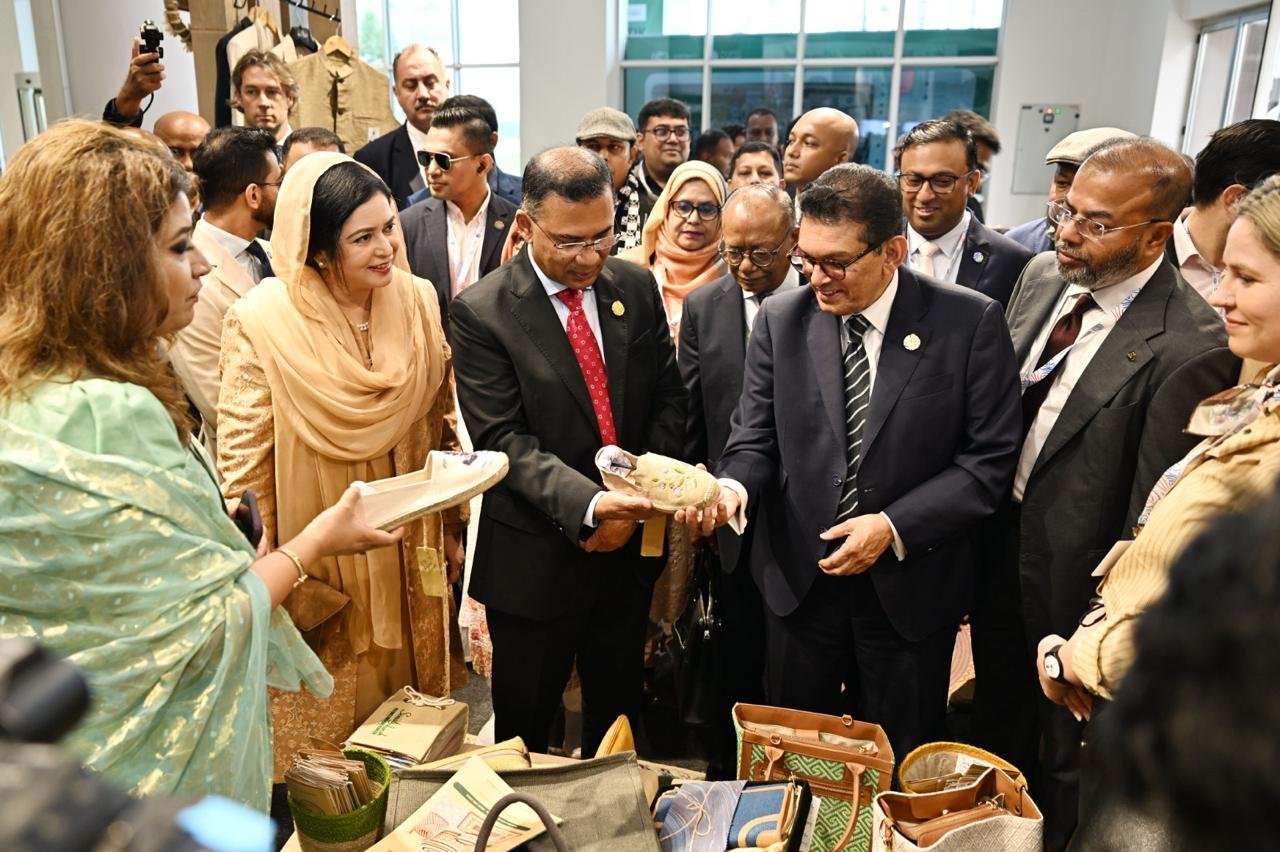
In a related development, Tarique visited Bangladesh’s Jute Pavilion in the Green Zone of COP31 on Thursday morning, highlighting the country’s ambition to turn traditional jute into a global alternative to environmentally harmful products.
He was welcomed by State Minister for Foreign Affairs Shama Obaed and State Minister for Environment, Forest and Climate Change Sheikh Faridul Islam.
The Prime Minister inspected various jute-based products displayed at the pavilion, including bags, footwear, blazers and other consumer goods. Pavilion officials said 129 types of jute products were being showcased.
During the visit, Tarique also interacted with a group of students from the University of Chicago in the United States who were visiting the pavilion.
The students expressed interest in learning more about Bangladesh’s environmentally friendly jute products and exploring the subject further.
The Prime Minister urged everyone to work together to protect the environment and ensure a healthy and sustainable future for humanity.
According to pavilion officials, representatives from several countries had already shown interest in Bangladeshi jute products, with some expressing interest in importing them.
The visit sends an important message: Bangladesh’s climate response should not be limited to seeking international financial assistance. It should also create economic opportunities through green manufacturing, sustainable trade and environmentally responsible industries.
Jute, once a major pillar of Bangladesh’s export economy, could regain international significance as countries increasingly seek alternatives to plastic and other environmentally damaging materials. However, realising this potential will require product innovation, quality certification, competitive pricing, investment and access to international markets.
Foreign interest at a climate conference is an encouraging signal, but it must translate into commercial partnerships and sustained export growth.
The diplomatic test: Turning promises into action
Tarique’s COP31 address seeks to position Bangladesh not merely as a climate-vulnerable country asking for assistance, but as a developing economy demanding fairness in the global climate system while presenting its own development commitments.
His call for grants rather than loans is particularly important at a time when climate-related losses, infrastructure damage and adaptation requirements are adding pressure to the finances of vulnerable economies.
The demand for 50 per cent of international climate finance to go towards adaptation also addresses a longstanding concern of developing countries: that mitigation and emissions-reduction initiatives often receive greater attention and financing than the immediate needs of communities facing floods, cyclones, coastal erosion and displacement.
For Bangladesh, the challenge is particularly acute in coastal districts, riverine islands and densely populated urban centres. Climate resilience requires investment in embankments, cyclone shelters, resilient infrastructure, freshwater management, agricultural adaptation and protection for displaced communities.
The Prime Minister also stressed the importance of ensuring the participation of women and young people in climate action, creating decent green jobs and keeping the 1.5-degree Celsius global warming target within reach.
Foreign Minister Khalilur Rahman, Environment, Forest and Climate Change Minister Abdul Awal Mintoo, State Minister for Foreign Affairs Humayun Kabir and other officials were present during the Jute Pavilion visit.
Bangladesh has called for a meaningful, balanced and ambitious outcome from COP31.
But the real measure of the conference will not be the number of declarations or diplomatic commitments. It will be whether developed countries deliver adequate grants, facilitate technology transfer and establish fair financing mechanisms that enable vulnerable nations to protect their people without sinking deeper into debt.
For Bangladesh, the message from Antalya is clear: climate vulnerability must not become another source of economic vulnerability. Climate justice must be measured in financing delivered, communities protected and sustainable development achieved—not merely promises made.
