



Experts and business leaders have called for stronger regional economic cooperation and cross-border connectivity, saying Chattogram could become a major logistics hub linking Bangladesh with neighbouring countries.
They said the country’s economic potential could not be fully realised through domestic infrastructure development alone. Better use of Chattogram port, the Bay Terminal and Matarbari port, along with improved road, rail and waterway networks, would be essential to expand regional trade.
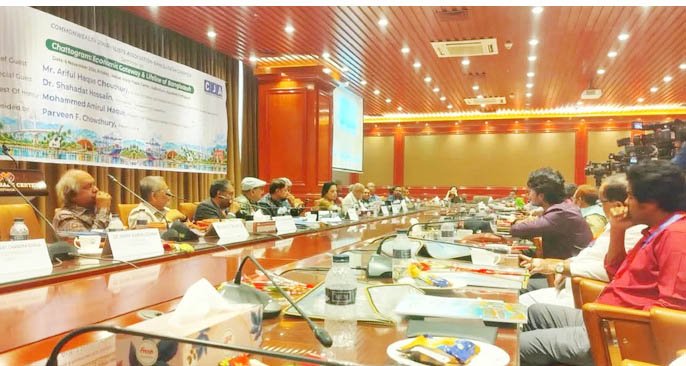
Speakers made these observations at a seminar titled “Chattogram: Economic Gateway & Lifeline of Bangladesh”, organised by the Commonwealth Journalists Association (CJA)-Bangladesh Chapter at the World Trade Centre in Agrabad.
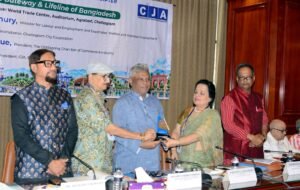
Chattogram City Corporation Administrator Dr Shahadat Hossain attended the event as the chief guest while Chittagong Chamber of Commerce and Industry (CCCI) President Mohammed Amirul Haque presented the keynote paper.
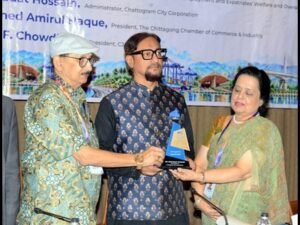
CJA-B President Parveen F. Chowdhury presided over the event.
Haque said the coordinated operation of Chattogram port, Matarbari port and the Bay Terminal could strengthen the country’s maritime trade capacity by accommodating different types of vessels.
International seaports generally require a draft of 18 to 20 metres, while Matarbari is being developed with nearly that depth. The Bay Terminal will have a draft of more than 11 metres, he said.
He further said Chattogram could offer a shorter and more economical cargo route for landlocked Nepal. Goods transported through Chattogram would cover around 1,200 kilometres, compared with nearly 2,000 kilometres through alternative ports.
He called for extending port and logistics facilities to India’s northeastern states, known as the Seven Sisters, Nepal and parts of Myanmar.
Haque also stressed the need to integrate innovation, logistics and manufacturing industries and make greater use of waterways to transport goods from Matarbari.
The lack of guaranteed utility services was discouraging investment, he said, adding that business organisations had repeatedly raised the issue.
He called for developing five motorways across the country and improving railway and waterway networks. Infrastructure projects should be evaluated on the basis of their long-term economic benefits before implementation, he added.
CBFTU Vice-Chancellor Professor Dr Obaidul Karim called for cluster-based economic development and stronger cooperation among neighbouring countries.
Citing Germany, Norway, Sweden, the United Kingdom and France, he said regional cooperation had helped neighbouring countries build strong economies.
He said the South Asian Association for Regional Cooperation (SAARC), which once offered significant prospects for regional development, was no longer functioning effectively.
Calling for its revival, Karim said South Asian countries could not fully realise their economic potential through bilateral relations and isolated trade initiatives alone.
He said Bangladesh’s development was linked to that of India, Nepal and Pakistan, adding that no country could achieve sustainable progress by excluding its neighbours.
Karim also called for greater international promotion of Chattogram’s tourism and cultural heritage. Despite its natural beauty, the city had yet to emerge as an international tourist destination or an eco-tourism hub, he said.
Its traditional sampans, river-based lifestyle, mezban and Jabbarer Boli Khela could help promote Chattogram’s cultural identity internationally, he added.
Ekushey Padak-winning journalist and The Daily Azadi Editor M. A. Malek stressed the need for administrative decentralisation, saying Chattogram’s institutional authority did not reflect its economic importance.
He said many important functions had gradually been transferred from Chattogram to Dhaka, despite modern communication technology making it easier to operate institutions from different parts of the country.
Referring to the long-standing promise of making Chattogram the country’s commercial capital, Malek said no bank or insurance company had its headquarters in the port city.
He said Chattogram had the potential to achieve international prominence through commercial activities but needed long-term planning and a change in policymakers’ outlook.
He expressed hope that the city would become both the lifeline of the national economy and a model for quality of life.
Moderated by AP Bangladesh Bureau Chief Julhas Alam , the program was attended among others by CJA Secretary General Osman Gani Mansur, Dhaka Flash Editor-in-Chief Farid Hossain, National Press Club President Hasan Hafiz, Chattogram Development Authority Chairman Engineer Belayet Hossain, International Business Forum, Chattogram President S. M. Abu Tayyab, Premier University Dean of Arts Professor Mohit Ul Alam and public health specialist and clinical epidemiologist Professor Dr Pravat Chandra Barua.
Journalists from four districts, researchers, planners, academics and other professionals also joined the seminar.
