



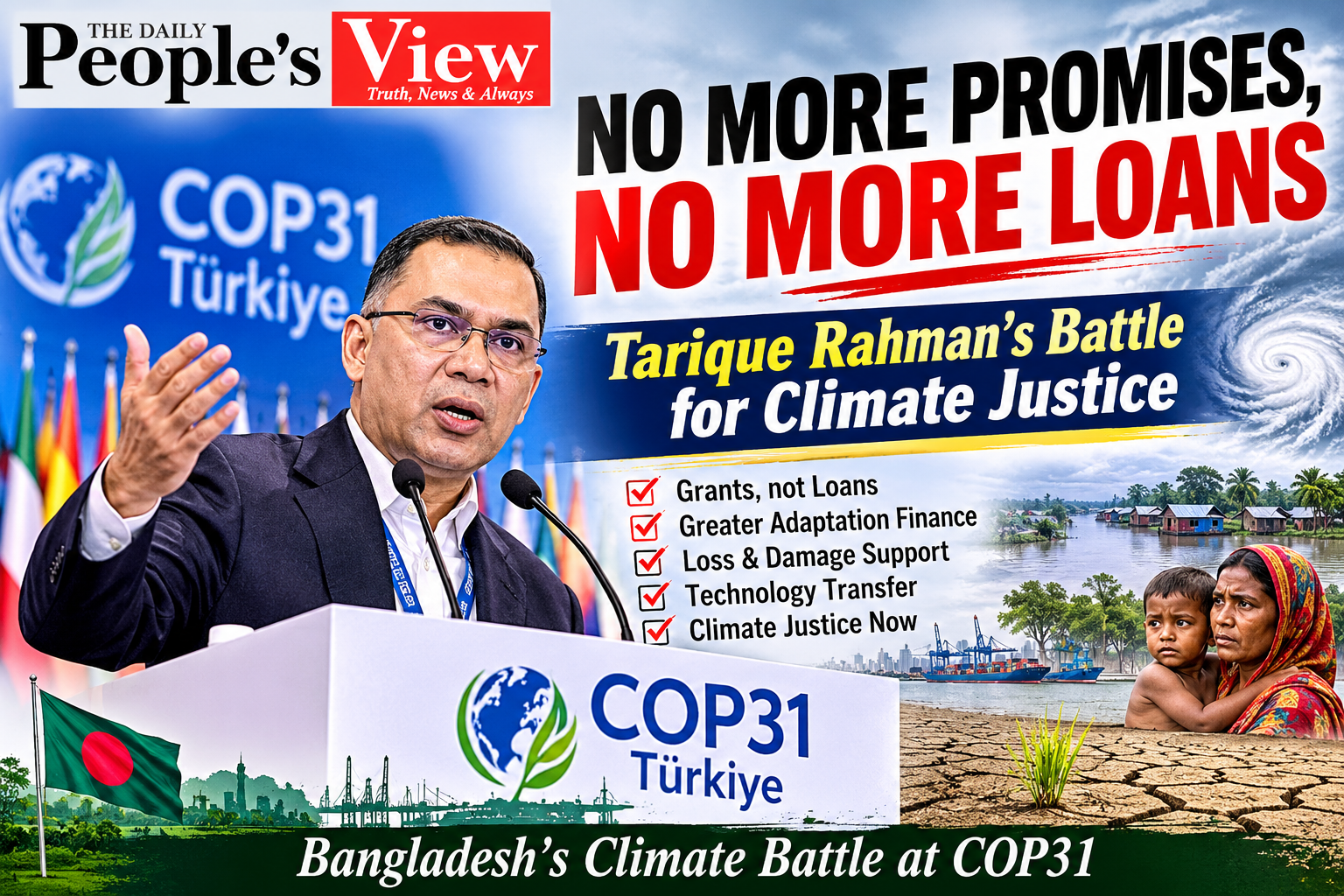
As Prime Minister Tarique Rahman takes Bangladesh’s demands to world leaders in Antalya, the country must confront the wealthy polluters over their historical responsibility, broken financial commitments and continued failure to protect the most vulnerable. Bangladesh needs justice, not sympathy; grants, not loans; and action, not another declaration.
Bangladesh has come to COP31 with a message that the world’s wealthiest nations can no longer afford to ignore: those who contributed most to the climate crisis must stop making the most vulnerable pay its price.
For decades, industrialised economies have built their prosperity on fossil fuels, carbon-intensive industries and the uncontrolled exploitation of natural resources. Yet countries like Bangladesh, which have contributed very little to historical global emissions, are now being forced to spend billions protecting their people, infrastructure and economies from the consequences.
This is not simply an environmental crisis. It is a question of international responsibility, economic inequality and climate justice.
Prime Minister Tarique Rahman’s participation in the World Leaders’ Summit in Antalya on November 11–12 gives Bangladesh an opportunity to confront this injustice at the highest political level. His scheduled address to the plenary session on November 12 should be more than a diplomatic statement of concern. It should be a forceful demand for accountability from those who have the greatest responsibility and financial capacity to act.
Bangladesh must make one thing clear: it is no longer willing to accept sympathy in place of financing, loans in place of compensation, or ambitious declarations in place of measurable action.
The climate finance hypocrisy: Why should victims borrow to survive?
The biggest contradiction in international climate diplomacy is that countries suffering the consequences of climate change are frequently expected to borrow money to protect themselves.
Bangladesh is demanding grants, not loans, to finance adaptation and address climate-related losses. The argument is straightforward: why should a country that contributed almost nothing to the historical accumulation of greenhouse gases increase its debt to deal with a crisis largely driven by industrialised nations?
The wealthy countries have repeatedly acknowledged their responsibility to support developing economies. Yet the gap between announced commitments and actual financing remains a major source of frustration.
At COP29 in Baku, developed countries agreed to take the lead in mobilising at least $300 billion annually by 2035 for developing countries, while the wider ambition was set at $1.3 trillion annually from all sources.
But a financial target is not a cheque. Nor does money mobilised through commercial investment or debt automatically constitute meaningful assistance to countries facing climate emergencies.
Bangladesh should challenge the quality, accessibility and additionality of climate finance, not merely its headline amount.
It should demand:
- A substantially greater share of grant-based financing.
- Predictable and additional resources for adaptation.
- Simplified access to international climate funds.
- Transparent reporting on actual disbursement rather than announced pledges.
- Financial support that does not deepen the debt burden of vulnerable economies.
The Prime Minister should challenge international leaders to explain why countries with limited historical responsibility should continue paying interest on loans to protect themselves from a crisis they did little to create.
Loss and damage: The world cannot keep delaying compensation
For Bangladesh, climate damage is not a future prediction. It is happening now.
River erosion is swallowing homes and farmland. Cyclones are destroying coastal settlements. Salinity is undermining agriculture and freshwater supplies. Flooding is damaging businesses, roads and essential infrastructure. Families are losing their livelihoods and, in many cases, their ancestral homes.
These losses cannot always be reversed by building another embankment or installing a better warning system.
The establishment of the Fund for Responding to Loss and Damage was celebrated as a breakthrough in climate negotiations. But vulnerable countries cannot rebuild their lives with institutional announcements and symbolic contributions.
The real questions are: How much money is available? Who is contributing? How quickly can affected countries access it? And how much actually reaches the communities that have suffered?
Bangladesh should demand a properly capitalised and accessible fund, with predictable contributions and a strong grant-based component.
It must also insist that loss and damage includes more than destroyed buildings and damaged infrastructure. The disappearance of islands, loss of ancestral land, destruction of traditional livelihoods, cultural heritage and permanent displacement are equally serious consequences.
The wealthy nations cannot continue recognising these realities in speeches while avoiding meaningful financial responsibility.
Adaptation finance: Survival cannot depend on Bangladesh’s limited resources
Bangladesh has demonstrated considerable resilience through investments in cyclone preparedness, disaster management and community-level adaptation. But resilience should not become an excuse for international inaction.
The country cannot endlessly compensate for the consequences of global emissions through its own limited resources.
Its National Adaptation Plan 2023–2050 identifies the scale of the challenge. Implementing it requires massive investment in coastal protection, flood management, agriculture, freshwater security, urban infrastructure and disaster preparedness.
Bangladesh’s demand for a threefold increase in adaptation finance must therefore become a major negotiating priority.
It should challenge developed countries to move beyond vague commitments and support measurable programmes that protect lives and economic assets.
The government must also resist attempts to treat adaptation as a secondary issue compared with emissions reduction.
For a country already facing recurrent floods, cyclones, erosion and salinity intrusion, adaptation is not optional. It is a matter of national survival.
Chattogram: When climate injustice threatens the national economy
Bangladesh’s climate battle should not be confined to vulnerable villages and coastal settlements. It must also address the growing risks to its economic infrastructure.
Chattogram is the country’s principal maritime gateway, hosting its largest seaport, export-processing industries and critical trade networks.
Climate-induced flooding, waterlogging, cyclones, landslides, coastal erosion and sea-level rise threaten communities and economic assets that sustain national growth.
Damage to the port and its supporting infrastructure would have consequences far beyond Chattogram. It could disrupt international supply chains, exports, employment and the country’s economic security.
The government should therefore place climate-resilient Chattogram on the international investment agenda.
Bangladesh should demand financing and technology for:
- Modernising port and coastal infrastructure.
- Protecting industrial zones from flooding and storm surges.
- Improving urban drainage and restoring canals.
- Strengthening coastal embankments and disaster protection.
- Developing renewable energy and sustainable industrial operations.
The message to international partners should be clear: protecting Bangladesh’s economic infrastructure also protects international trade and regional economic stability.
Climate displacement: A humanitarian crisis the world refuses to confront
Another uncomfortable reality of climate diplomacy is the absence of adequate international protection and financing for people forced to leave their homes because of climate change.
In Bangladesh, river erosion, salinity, cyclones and coastal flooding are pushing families towards displacement and uncertain livelihoods.
These people are not necessarily migrating because they want a different economic opportunity. Increasingly, they are leaving because their homes, farmland and traditional sources of income are disappearing.
Yet the international climate system still lacks a comprehensive framework to finance and coordinate the protection, rehabilitation and planned relocation of climate-displaced populations.
Bangladesh should demand international recognition of climate displacement as a major humanitarian and development challenge.
It should seek support for planned relocation, housing, alternative livelihoods, education, healthcare and social protection.
The world cannot claim to defend vulnerable communities while leaving millions of climate-displaced people without an adequate international support mechanism.
Tarique Rahman’s diplomatic test: Speak firmly, negotiate strategically
Prime Minister Tarique Rahman’s participation in COP31 comes with an important responsibility.
His November 12 plenary address should not be another carefully worded appeal for global solidarity. It should challenge the contradiction between the climate commitments of wealthy nations and their actual performance.
The Prime Minister should make three arguments unmistakably clear.
First, historical responsibility must carry financial consequences. Climate finance cannot remain a voluntary expression of generosity.
Second, vulnerable countries must not be pushed further into debt to address climate damage caused disproportionately by others.
Third, the international community must establish measurable, transparent and time-bound mechanisms to deliver financing and technology to countries that need them most.
His bilateral meetings with Turkish President Recep Tayyip Erdoğan and other international leaders provide additional opportunities to build political support, secure partnerships and attract investment.
Türkiye’s role as host and Australia’s leadership of the formal negotiations also make engagement with both countries particularly important.
But diplomatic engagement must have clearly defined objectives. A meeting, handshake or joint photograph is not a climate achievement. A funded programme, technology agreement or concrete financing commitment is.
Bangladesh must also strengthen its alliances with the Least Developed Countries Group, the G77 and China, and the Climate Vulnerable Forum. The collective bargaining power of vulnerable countries is essential to challenging the influence of major economic and industrial powers.
Green transition: Developing countries must not be punished for pursuing development
The transition to a low-carbon economy is essential, but it must not become another instrument of economic inequality.
Bangladesh needs renewable energy, cleaner manufacturing, energy efficiency and modern industrial technologies. Yet it cannot be expected to finance the transition entirely through its own resources while competing against economies that have benefited from decades of carbon-intensive industrial development.
The international community must provide affordable technology, investment and technical assistance.
A just transition must also protect employment and export competitiveness, particularly in the ready-made garment industry and other labour-intensive sectors.
Bangladesh’s proposed showcase of jute-based biodegradable products at COP31 offers a practical example of how developing countries can contribute to global environmental solutions.
The envisaged cooperation with Türkiye on promoting jute and jute products could open opportunities for research, investment, technology transfer and international markets.
But green industrialisation must be supported by real partnerships, not merely celebrated in conference exhibitions.
Bangladesh must stop measuring success by diplomatic applause
Perhaps the greatest danger for Bangladesh at COP31 is returning home with impressive speeches, declarations and expressions of international support but little money or practical assistance.
The country has participated in decades of climate negotiations. It has repeatedly highlighted its vulnerability, presented scientific evidence and demanded international responsibility.
Yet the fundamental gap between climate commitments and implementation remains.
This time, Bangladesh needs a different approach.
Every commitment secured in Antalya should be followed by a clear implementation plan, identifying the responsible ministry, financing source, timeline and measurable outcome.
The government should establish a national COP31 follow-up mechanism involving relevant ministries, climate experts, universities, businesses, civil society and local authorities.
The media and affected communities should also be able to monitor whether promised support actually reaches the intended beneficiaries.
Bangladesh must also ensure that climate diplomacy is connected to domestic accountability. International grants and investment will achieve little without transparent project selection, institutional coordination and effective implementation.
The battle is about justice, dignity and the right to development
COP31 is taking place at a moment when the credibility of international climate diplomacy is being tested.
The world has already recognised the climate crisis. It has adopted agreements, announced targets and established funds. What remains deeply contested is whether those with the greatest historical responsibility are prepared to pay the real cost of addressing the damage.
Bangladesh cannot afford another conference dominated by promises that disappear after the closing ceremony.
Prime Minister Tarique Rahman’s visit offers an opportunity to make the country’s voice stronger and its demands more difficult to ignore.
Bangladesh should leave Antalya with a clear negotiating record, stronger alliances, financing commitments and concrete international partnerships.
Its position should be uncompromising on the principles but strategic in diplomacy.
Bangladesh is not asking the wealthy world for charity. It is demanding responsibility. It is not asking for sympathy for its suffering. It is demanding justice for the consequences of a crisis it did little to create.
The time for empty promises is over. The time for climate justice is now.
And if COP31 cannot translate decades of international commitments into real support for countries like Bangladesh, the credibility of the entire global climate process will remain in question.
