



Saleh Noman
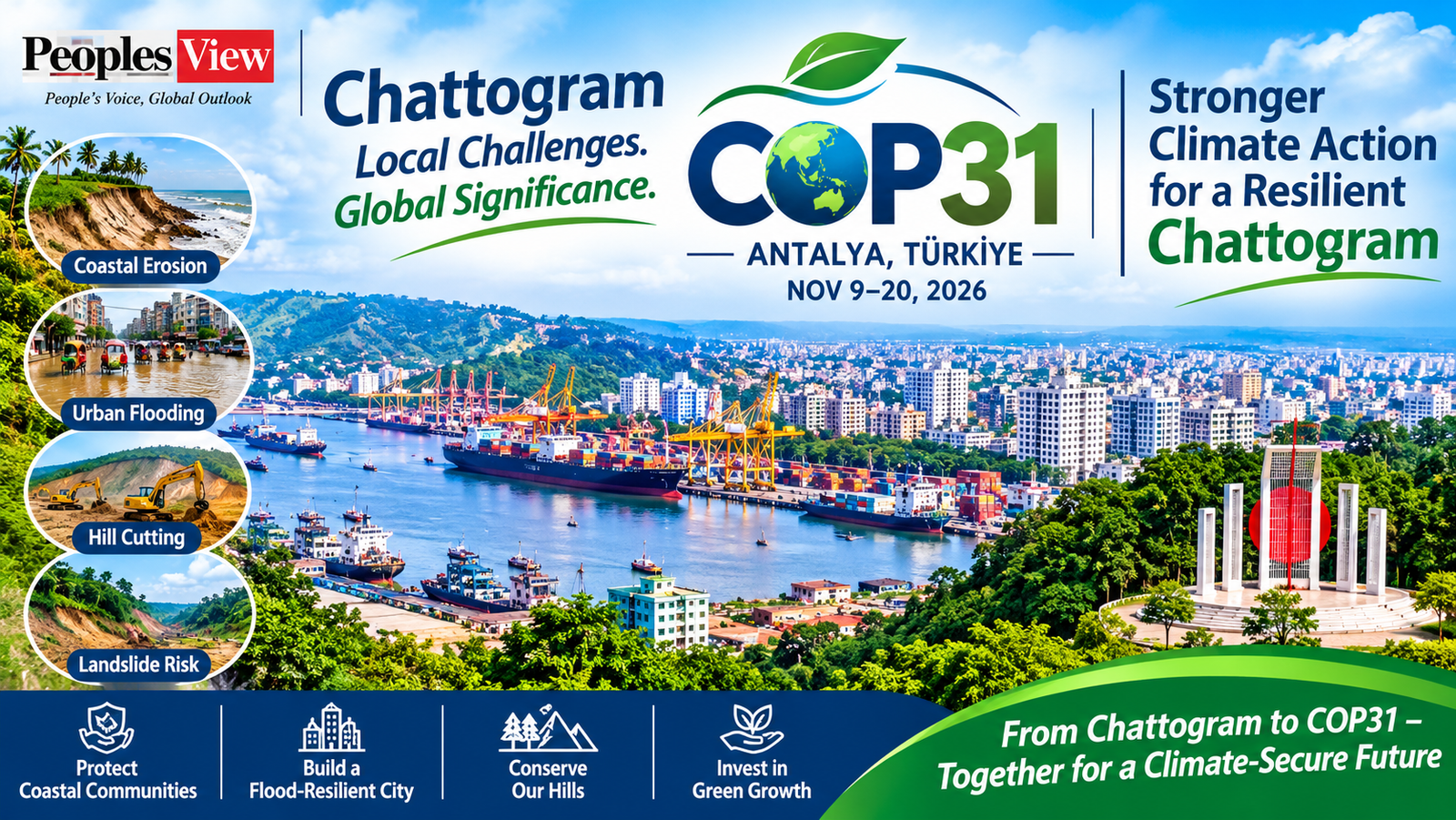
Coastal erosion, urban flooding and disappearing hills threaten communities and economic infrastructure, putting Bangladesh’s principal port city at the centre of a growing climate resilience challenge.
Urir Char, on the coast near Chattogram, is a stark reminder of how the sea can take away more than land. It threatens homes, livelihoods and the future of communities already struggling with repeated environmental losses.
For residents of Sandwip Island and adjoining Urir Char, a settlement established around four decades ago, coastal erosion is a recurring battle against the forces of nature. In the hills surrounding Chattogram city, unregulated excavation and deforestation are increasing the risks of landslides. Meanwhile, even a few hours of heavy rainfall can turn major urban roads into waterways, disrupting businesses, transport and everyday life.
“We have spent years building our homes and livelihoods here, but the land keeps disappearing. Every time the river takes another piece of our land, we fear that one day we will have nowhere left to go,” said a resident of Urir Char, describing the uncertainty facing families along the eroding coastline.
These challenges are unfolding in one of Bangladesh’s most economically important regions, home to the country’s principal seaport, major industrial facilities and extensive coastal settlements.
As world leaders and climate negotiators gather in Antalya, Türkiye, for the United Nations climate conference COP31 from November 9 to 20, Chattogram faces an opportunity to bring its environmental challenges into the global debate.
“Chattogram represents a combination of climate-related and human-induced environmental risks. Coastal erosion, unplanned urbanisation, hill cutting and inadequate drainage are interconnected challenges. Addressing them requires scientific assessment, ecosystem-based adaptation and coordinated long-term planning rather than isolated infrastructure projects,” said Prof Manzurul Kibria an environmental expert of Chattogram.
The question is whether the conference can help transform the region’s growing climate vulnerability into international cooperation, investment and practical solutions.
Climate change is no longer only an environmental issue. It is increasingly a question of economic security, human displacement and sustainable development.
## A coastline disappearing, communities under pressure
Coastal erosion is among the most persistent environmental threats facing Chattogram’s wider coastal region, particularly Sandwip and settlements along the Meghna estuary and the Bay of Bengal.
Changing river channels, tidal action, sediment movement and rising sea levels combine to make the coastline increasingly vulnerable. The consequences are felt by families who lose agricultural land, homes, roads and sources of income.
Over the past five decades, riverbank and coastal erosion have reshaped Bangladesh’s landscape, destroying homes, farmland and livelihoods. A satellite-based study found that about 84,437 hectares (844 sq km) of coastal land disappeared between 1972 and 2020, although sediment deposits created new land elsewhere. For thousands of displaced families, however, these gains offer little compensation for the loss of their homes and ancestral land.
For some communities, relocation has become an unavoidable reality.
The human dimension was highlighted the experience of the coastal community near Chattogram.
” The sea is taking our village back,” said Josna Rani Jaldas, describing the repeated losses suffered by her community. She and other residents had already left their original homes in Sandwip because of cyclones, tidal waves and river erosion.
Their experience illustrates how environmental displacement can become a cycle in which families repeatedly seek safety but remain exposed to new risks.
The problem has also attracted attention from national policymakers. State Minister for Land and Chattogram Hill Tracts Affairs Mir Mohammad Helal Uddin, speaking at a coastal dialogue at the Chattogram Press Club recently, acknowledged the vulnerabilities of Sandwip and other coastal communities.
He outlined the government’s intention to address erosion, improve transport systems and tackle illegal activities affecting coastal populations. He also said development in coastal areas was a government responsibility rather than an act of charity.
For COP31, Chattogram’s coastal crisis presents an opportunity to strengthen international discussions on adaptation, loss and damage, and climate-induced displacement.
The region needs comprehensive coastal vulnerability mapping, sustainable embankments, mangrove restoration and long-term rehabilitation programmes for displaced families.
Such initiatives could also provide a model for other vulnerable coastal communities across South Asia.
Urban flooding exposes the cost of inadequate planning
While coastal communities face the gradual loss of land, Chattogram city is struggling with a different but interconnected challenge: recurring urban flooding.
The problem was dramatically exposed on April 28, 2026, when approximately 85 millimetres of rainfall was recorded between 8 a.m. and 3 p.m. Major roads in Prabartak, Chawkbazar, Katalganj, Muradpur, Agrabad and Halishahar became submerged, with water reaching knee and waist levels in several locations.
The flooding disrupted traffic, damaged businesses and affected residents, students and office workers.
Reporting by medias found that blocked canals, incomplete drainage works, delayed funding and poor coordination among government agencies had contributed to the crisis.
Delwar Majumder, former president of the Institution of Engineers, Bangladesh, Chattogram Centre, criticised the prolonged implementation of the city’s drainage improvement project, saying a project originally designed for three years had remained unfinished even after eight years.
The broader drainage project, initially approved in 2017, saw its budget increase from Tk5,616 crore to Tk8,626 crore.
Chattogram City Corporation Mayor Dr Shahadat Hossain has acknowledged the scale of the challenge and called for coordinated action to restore the city’s natural drainage system.
In June, he presented a proposed Tk3,549 crore masterplan to restore 21 canals, with the possibility of expanding the programme to 40-50 waterways.
Survey findings presented during the proposal indicated that accumulated silt had reduced canal drainage capacity by around 40%. The mayor estimated annual economic losses from waterlogging at approximately Tk65 crore.
The proposed programme includes canal excavation, pumping stations, tidal regulators and other infrastructure intended to improve drainage capacity.
However, the challenge extends beyond engineering. Encroachment on waterways, unplanned urbanisation, the filling of low-lying areas and inadequate waste management have contributed to the city’s growing vulnerability.
Climate change adds another layer of pressure. More intense rainfall can overwhelm already inadequate drainage systems, while high tides can restrict the discharge of rainwater into surrounding rivers.
Chattogram therefore needs an integrated urban climate adaptation strategy combining drainage restoration, flood forecasting, protection of wetlands and stronger coordination among public agencies.
Disappearing hills, rising landslide risks
The hills surrounding Chattogram are another critical part of the region’s environmental security.
Over the past five decades, Chattogram city has lost around 120 of its estimated 200 hills, according to environmental studies and reports. The total hill area shrank from 32.37 square kilometres in 1976 to about 14.02 square kilometres in 2008—a decline of nearly 57 per cent. The destruction of hills for housing, roads and urban development has increased the city’s vulnerability to landslides, flooding and environmental degradation.
For decades, hill cutting, deforestation, unplanned housing and construction have altered the natural landscape. During intense rainfall, these activities can increase the likelihood of landslides, particularly in settlements located on unstable slopes.
The issue has repeatedly attracted national attention.
In January 2025, former environment adviser Syeda Rizwana Hasan visited the Akbar Shah area of Chattogram and warned against illegal hill cutting and unplanned settlements.
She called for action against hill owners involved in destructive activities, arguing that enforcement should target those responsible rather than merely the workers carrying out excavation.
She also emphasised the importance of coordination among government agencies, local communities and environmental organisations.
Her remarks highlighted a wider policy problem: environmental protection requires consistent enforcement, not occasional eviction drives or temporary restrictions.
Hill conservation should therefore become part of Chattogram’s climate adaptation agenda.
Scientific mapping of vulnerable slopes, restoration of vegetation, protection of natural drainage channels and relocation support for high-risk communities could reduce the dangers.
The issue is also relevant to the wider Chattogram Hill Tracts, where communities face combinations of landslides, flash floods, erratic rainfall and other climate-related hazards.
Protecting the port means protecting the economy
Chattogram’s climate vulnerability has implications far beyond its immediate population.
The city is home to Bangladesh’s principal seaport, which handled approximately 3.4 million twenty-foot equivalent units (TEUs) of containers in 2025. The port is central to the country’s international trade, while surrounding industrial facilities and export-processing zones support hundreds of thousands of jobs.
A major cyclone, prolonged flooding or disruption to transport infrastructure could affect port operations, manufacturing, logistics and supply chains.
Climate adaptation in Chattogram should therefore be viewed as an economic investment rather than simply an environmental expenditure.
The region needs climate-risk assessments for ports, industrial zones, roads and logistics infrastructure, alongside investment in flood-resistant facilities, renewable energy and sustainable maritime operations.
Such measures could also strengthen Bangladesh’s position as an increasingly important manufacturing and trading economy.
The challenge is particularly relevant as international businesses face growing pressure to improve the environmental sustainability and resilience of their supply chains.
COP31: An opportunity to connect local problems with global priorities
The upcoming climate conference provides an opportunity to connect Chattogram’s experience with international discussions on adaptation finance, loss and damage, ecosystem restoration and climate-resilient cities.
Bangladesh is already preparing to make climate finance a central issue at COP31.
Environment, Forest and Climate Change Minister Abdul Awal Mintoo said on November 5 that Bangladesh would seek increased grant-based climate financing, particularly for adaptation and addressing climate-related losses and damage.
He said the country would press for easier access to climate funds and support that would not increase the debt burden of vulnerable nations.
Bangladesh also intends to seek assistance for early-warning systems, local adaptation, protection of vulnerable communities, technology transfer and the conservation of mangroves, wetlands and biodiversity.
These priorities closely reflect Chattogram’s needs.
However, the region must ensure that its specific challenges are clearly represented in the national climate agenda.
Coastal erosion in Sandwip, urban flooding in Chattogram city and hill degradation should not remain separate local concerns. They should be presented as interconnected examples of the economic and humanitarian consequences of climate vulnerability.
International organisations, including the World Bank, Asian Development Bank, UNDP and UN-Habitat, could be important partners in developing regional adaptation programmes, technical assessments and investment proposals.
Access to the Green Climate Fund, Adaptation Fund and other international financing mechanisms could help support these programmes, subject to project eligibility and the required national and institutional approvals.
From climate vulnerability to investment-ready solutions
For Chattogram, international recognition alone will not be enough. The region needs a coordinated strategy that translates climate diplomacy into projects capable of attracting investment and delivering measurable results.
Five areas deserve priority.
First, a comprehensive coastal resilience programme should address erosion, embankment protection, mangrove restoration and livelihood rehabilitation, particularly in Sandwip and other vulnerable coastal settlements.
Second, Chattogram city needs an integrated flood-management programme combining canal restoration, modern drainage infrastructure, flood forecasting and protection of natural water-retention areas.
Third, hill conservation requires stronger enforcement, scientific risk mapping, ecosystem restoration and safe housing for people living in landslide-prone areas.
Fourth, the port and industrial economy need a climate-resilient infrastructure programme to protect trade, investment, employment and supply chains.
Finally, climate displacement should receive greater attention through systematic documentation, planned relocation, livelihood restoration and social protection.
These initiatives require cooperation among the national government, Chattogram City Corporation, Chittagong Port Authority, Chattogram Development Authority, universities, businesses and civil society organisations.
A permanent regional climate resilience platform could bring these stakeholders together to prepare research, identify priority projects and maintain international partnerships beyond COP31.
Making Chattogram’s voice heard
The region’s participation in global climate discussions should not be limited to government officials.
Journalists, researchers, environmental organisations, business representatives and affected communities all have important roles in communicating the realities of climate vulnerability.
Local voices can provide the human evidence behind scientific assessments, while universities and research institutions can supply data and technical expertise.
The proposed dialogue, “Chattogram to COP31: Climate Risk, Economic Growth and Environmental Accountability”, scheduled for November 15 at the Bangladesh Pavilion, offers an opportunity to bring these perspectives together.
The discussion should focus not only on the problems but also on practical proposals for international cooperation, investment and local implementation.
Chattogram’s message to the international community should be straightforward: protecting vulnerable coastal communities, restoring urban ecosystems and securing critical economic infrastructure are mutually reinforcing priorities.
The region is not simply seeking assistance because it is exposed to climate change. It is seeking partnerships to protect an economically strategic part of Bangladesh and build a more resilient future for its people.
COP31 will not solve Chattogram’s environmental problems. Nor can international climate finance substitute for effective local governance, responsible urban planning and enforcement of environmental laws.
But the conference can help bring global attention, expertise and financing to a region where environmental degradation increasingly threatens both human security and economic development.
For Chattogram, the measure of success will not be how prominently it features in conference discussions, but whether those discussions lead to stronger coastal protection, safer cities, restored hills and better livelihoods.
The challenge is to turn global climate commitments into local results — and ensure that Chattogram is no longer merely a place discussed in the language of climate vulnerability, but a region supported in building climate resilience.
