



BIG-B expansion puts Matarbari port, regional connectivity and geopolitical balancing at the centre of Bangladesh’s economic ambitions
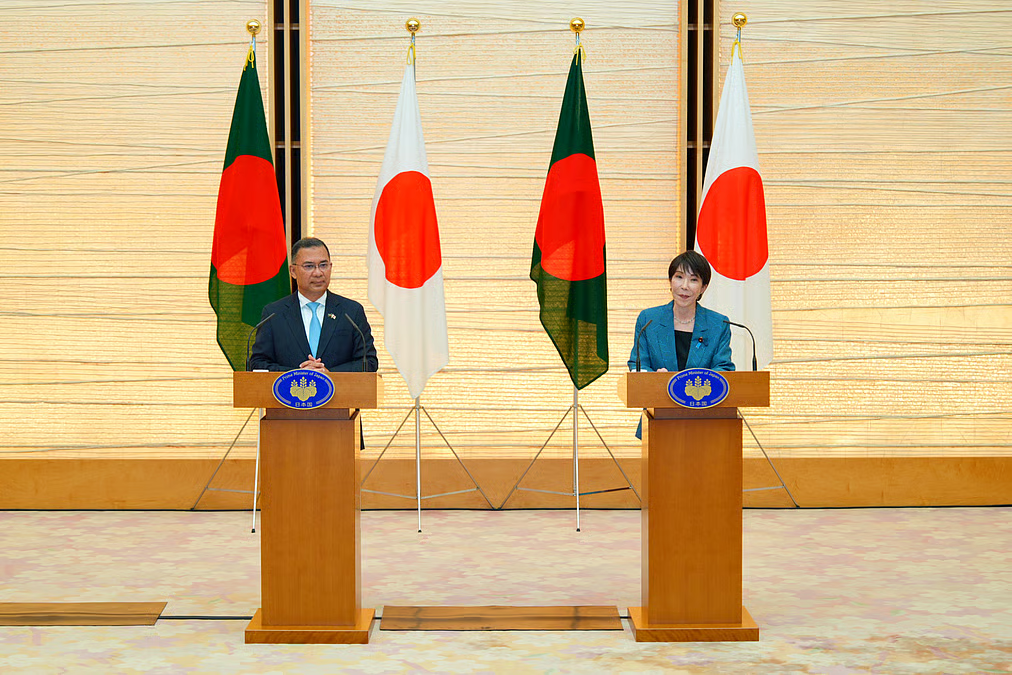
Prime Minister Tarique Rahman’s Japan visit has placed the Maheshkhali–Matarbari development hub at the centre of Bangladesh’s ambition to transform its strategic position on the Bay of Bengal into an engine of industrialisation, regional trade and economic influence.
The most consequential development is the Bangladesh–Japan commitment to upgrade their flagship Bay of Bengal Industrial Growth Belt (BIG-B) initiative into “BIG-B for Shared Prosperity.” The expanded framework envisages integrating deep-sea port infrastructure, energy, manufacturing, logistics and information technology, with Matarbari serving as a key anchor.
Under the vision endorsed by Tarique and Japanese Prime Minister Sanae Takaichi, Maheshkhali–Matarbari is expected to emerge as a major industrial, energy and logistics centre. Japan has also welcomed the prospect of up to one trillion yen in Japanese private-sector investment in Bangladesh over the next five years, potentially creating around 200,000 jobs.
The initiative signals a potential shift in bilateral relations—from a partnership historically associated with development assistance and infrastructure financing towards a commercially driven relationship built around industrial investment, resilient supply chains and regional economic integration.
But the real test will be whether Bangladesh can translate diplomatic commitments into operational infrastructure, competitive industries and reliable cross-border trade.
Maheshkhali–Matarbari: More than a port
At the heart of the strategy is the proposed Matarbari deep-sea port in Cox’s Bazar and the wider Maheshkhali–Matarbari Integrated Infrastructure Development Initiative.
The ambition extends beyond building a port. The development model envisages an integrated economic zone where maritime transport, industrial production, energy infrastructure and logistics reinforce one another.
For Bangladesh, the opportunity is substantial. The export-oriented economy depends heavily on efficient maritime transport, while industrial expansion requires reliable energy supplies, faster cargo movement and access to international markets.
A modern deep-sea port could improve Bangladesh’s ability to accommodate larger vessels and reduce dependence on regional transshipment hubs. Integrated industrial zones could attract Japanese manufacturers seeking to diversify their production networks, while improved logistics could help domestic businesses reach international markets more efficiently.
The initiative could also shift part of Bangladesh’s industrial growth towards the southeastern coast, creating a stronger connection between manufacturing centres and maritime trade.
However, the port alone cannot deliver that transformation. Roads, railways, energy supplies, customs modernisation, industrial land and efficient port operations must develop together. Without complementary investment, Matarbari risks becoming an expensive infrastructure asset rather than the foundation of a regional economic hub.
Connecting South Asia with Southeast Asia
Japan’s regional vision gives the project significance beyond Bangladesh’s borders.
Matarbari is being positioned as a potential maritime gateway connecting Bangladesh with northeastern India, Nepal, Bhutan and wider Southeast Asian markets. The proposed network could combine maritime transport with road, rail and inland logistics to link production centres across national boundaries.
For India’s northeastern states, improved access to Bangladeshi ports could create alternative routes for imports and exports, potentially reducing transport costs. Nepal and Bhutan could gain improved access to maritime trade, while Bangladesh could earn revenue from regional cargo and logistics services.
Japan has identified the development of an industrial value chain around Matarbari as an opportunity to connect northeastern India and the Bay of Bengal with Southeast Asia.
Yet this regional corridor remains an ambition, not an accomplished fact. Cross-border transport requires agreements on transit, customs, security, tariffs and infrastructure access.
The political relationship between Bangladesh and India will be particularly important. The experience of the Maitri Bridge over the Feni River, intended to strengthen connectivity between Bangladesh and India’s Tripura state, illustrates how political uncertainty can delay the benefits of infrastructure.
The lesson is clear: geography creates opportunities, but diplomacy determines whether they become commercially viable connections.
Japan, China and the Indo-Pacific balance
The Maheshkhali–Matarbari initiative also sits within a broader competition for economic influence across the Indo-Pacific.
China has expanded its regional presence through infrastructure financing, industrial investment and its Belt and Road Initiative. Japan, meanwhile, has promoted a Free and Open Indo-Pacific vision emphasising connectivity, economic resilience and maritime stability.
Bangladesh’s location between South and Southeast Asia, with a coastline on the Bay of Bengal, makes it strategically relevant to both.
Japan’s renewed focus on BIG-B suggests that Tokyo sees Bangladesh not merely as a recipient of development assistance but as a potential production and logistics partner in a wider regional economic network.
For Tarique’s government, the opportunity is to attract Japanese capital, technology and industrial expertise while maintaining constructive relations with China, India and other regional partners.
Bangladesh’s economic interests are unlikely to be served by turning infrastructure development into an exclusive geopolitical alignment. A commercially successful Matarbari hub should serve multiple trading partners and supply chains.
Its long-term value will depend on competitive costs, efficient operations and predictable regulations—not simply on which major power supports its development.
Tarique’s political test: From agreements to delivery
The Japan visit gives the new government an opportunity to demonstrate that Bangladesh can attract large-scale investment and build a more ambitious economic partnership with Tokyo.
The projected one-trillion-yen investment pipeline is significant, but it should not be confused with funds already invested or projects completed. Actual investment will depend on company-level decisions, financing arrangements, project preparation and Bangladesh’s business environment.
Investors will look for predictable taxation, efficient customs procedures, regulatory certainty, reliable energy supplies and transparent project implementation.
The government must therefore translate the political declaration into a measurable programme with clear timelines, financing plans, environmental safeguards and coordination among relevant agencies.
The political stakes are high. Large investment announcements generate expectations of jobs, industrial growth and improved living standards. Delays, cost overruns or weak implementation could undermine confidence in the government’s economic agenda.
The central question is whether Bangladesh can build the institutions and infrastructure needed to convert foreign investment into sustainable domestic economic capacity.
Development must benefit coastal communities
The proposed transformation also raises questions about who will benefit from development in Maheshkhali, Matarbari and the wider Chattogram–Cox’s Bazar region.
Large port and industrial projects can generate employment, expand local businesses and improve infrastructure. But those gains are not automatic. Local communities need skills training, decent employment and opportunities to participate in industrial supply chains.
Environmental safeguards are equally important in a coastal region exposed to cyclones, flooding, erosion and other climate-related risks. Industrial development must account for ecological sensitivity and the livelihoods of communities dependent on fisheries and coastal resources.
For the initiative to deliver shared prosperity, local workers and businesses must become participants in the emerging economy rather than bear only the costs of land acquisition, environmental pressure and rapid urbanisation.
A regional hub—or a missed opportunity?
Tarique’s Japan visit has elevated Maheshkhali–Matarbari from an infrastructure project to a central component of Bangladesh’s regional economic strategy.
The expanded BIG-B framework offers a potential route towards stronger industrial capacity, improved energy security and closer trade links between South Asia and Southeast Asia. It could strengthen Bangladesh’s position in regional supply chains as manufacturers seek to diversify production and reduce logistical risks.
But the opportunity comes with demanding conditions. Regional connectivity requires diplomatic cooperation, particularly with India. Industrial investment requires a predictable business environment. The port needs efficient supporting infrastructure, and local communities must receive tangible benefits.
The ultimate measure of Tarique’s Japan mission will not be the scale of the investment announced in Tokyo, but whether Bangladesh can turn Maheshkhali–Matarbari into a functioning centre of production, trade and regional cooperation.
If successful, the Bay of Bengal could become a platform for Bangladesh’s deeper integration with the wider region. If implementation falters, the promise of a regional powerhouse may remain confined to diplomatic declarations.
