



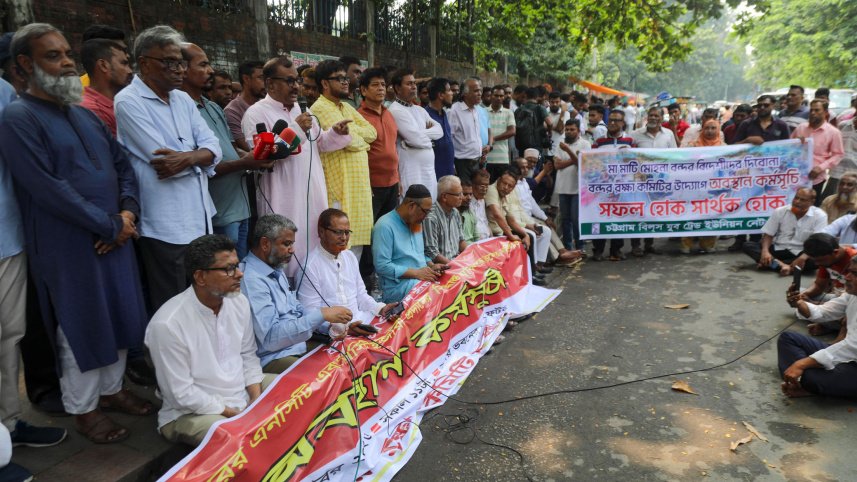
The battle over Chattogram Port exposed a widening gap between economic nationalism and internationalisation, but the opposition struggled to turn its concerns into a credible alternative.
The 15-year concession agreement between the Chattogram Port Authority (CPA) and Dubai-based DP World is the culmination of a process spanning three successive governments. The initiative began under Sheikh Hasina’s Awami League government, which pursued the appointment of an international operator for the New Mooring Container Terminal (NCT) under a public-private partnership framework, receiving in-principle approval in March 2023. The interim government led by Professor Muhammad Yunus subsequently advanced negotiations, although it suspended the process on 8 February 2026 following protests and a disruptive strike by port workers. After taking office, the BNP government led by Prime Minister Tarique Rahman revived the negotiations, with the CPA forming a support team in June. The process reached its decisive point on 8 October 2026
The protests against the 15-year concession agreement with DP World to operate the New Mooring Container Terminal (NCT) at Chattogram Port failed to stop the deal, which was signed on October 8, 2026. Despite opposition from port workers, labour organisations, leftist political groups and citizens’ platforms, the movement struggled to build a broad coalition capable of challenging the government’s case for internationalisation.
The outcome raises a fundamental question: why did a campaign framed around national interests, workers’ rights and control over strategic infrastructure fail to win wider public support?
The central weakness was that the campaign focused more on who should operate the terminal than on demonstrating which operating model would deliver greater benefits for Bangladesh. It raised concerns about foreign participation but struggled to establish, through evidence, why local operation would better serve the economy, workers and consumers.
However, the signing of the agreement does not prove that the public endorsed the deal or rejected the protesters’ concerns. It shows that the movement failed to change the government’s decision. Whether the concession serves Bangladesh’s national interest will depend on its terms, implementation and measurable results.
Nationalism failed to become a convincing economic argument
Chattogram Port is the principal gateway for Bangladesh’s international trade. Its efficiency affects exporters, importers, manufacturers, transport operators, consumers and government revenue. Delays and unpredictable cargo handling can raise business costs and weaken the competitiveness of Bangladeshi products.
For businesses, the immediate priority is reliable service, faster cargo handling and lower logistics costs. The operator’s nationality matters, but its significance ultimately depends on its performance.
The government’s case for DP World offered a straightforward proposition: an internationally experienced operator could bring investment, technology and modern management to improve terminal operations.
The opposition faced a more difficult challenge. It needed to demonstrate how local operators could deliver comparable or superior performance, what investment would be required and how accountability could be ensured.
Defending domestic operation simply because it is domestic could not establish that it would produce better results. A credible alternative required comparative performance data, a costed modernisation plan and measurable productivity targets.
The fundamental weakness was the failure to demonstrate convincingly that protecting local control would necessarily protect the national interest.
Public unfamiliarity with port operations limited the movement
The protesters themselves identified a major obstacle: many people outside the port sector, they believe, do not understand the realities of port operations. The technical nature of terminal management may have made it difficult for the wider public to assess competing claims about efficiency, ownership, employment and contractual risks.
Mohammad Ibrahim, a labour leader of Chattogram Port involved in the protest, said the government had ignored workers’ concerns and signed the agreement unilaterally. He said workers had raised their voices to protect national interests as well as their jobs and rights. Following the signing, he added, they would continue to press for the protection of their interests.
His remarks highlight a genuine grievance about workers’ participation in a decision affecting their professional future. But a grievance within a particular sector does not automatically become a wider public-interest movement.
The campaign needed to explain how the agreement might affect cargo-handling costs, government revenue, employment and the competitiveness of Bangladeshi businesses. It also needed to clarify what Bangladesh might gain or lose under the proposed arrangement.
Without accessible explanations and verifiable evidence, the debate remained difficult for people outside the port sector to evaluate.
The movement failed to build a broad coalition
Among political groups, leftist organisations were particularly vocal in opposing the agreement. But the campaign struggled to attract sustained participation from business leaders, civil society, political groups outside the port sector and ordinary citizens.
Hasan Maruf Rumi, chief coordinator of Ganosamhati Andolon in Chattogram, believes the movement failed to gain momentum because ordinary people, civil society members and political leaders outside the port sector did not become involved.
His assessment points to an important organisational weakness. Port workers could raise concerns about jobs and operational control, while exporters and manufacturers could have focused on logistics costs, reliability and competitiveness. Economists could have examined the financial terms, and governance advocates could have demanded greater transparency.
A coalition bringing these interests together might have transformed the dispute into a broader debate about the management of strategic infrastructure.
Instead, several organisations reportedly pursued the movement separately in Dhaka and Chattogram. Although this did not necessarily indicate a lack of commitment, fragmented efforts can make it difficult to develop a unified message and present a credible alternative.
The movement had visible opponents of the deal but struggled to turn them into a broad, coordinated force.
Local operators felt marginalised by globalisation
The controversy also exposed concerns about the recognition of domestic expertise.
Fazle Ikram Chowdhury, president of the Chattogram Port Berth Operators, Terminal Operators and Ship Handling Operators Owners Association, believes local voices were marginalised by globalisation. He argued that the contributions of local operators, businesses and workers throughout the port’s history had been overlooked. He also alleged that port personnel had been portrayed as corrupt, undermining public support for local operators.
His argument raises an important question: should internationalisation strengthen Bangladesh’s existing capabilities or displace them?
Local operators and workers possess experience and institutional knowledge developed over decades. A well-designed concession should seek to build on that expertise through local employment, skills development and technology transfer.
However, historical contributions alone cannot establish that domestic operators offer the best model for future operations. Local management must also demonstrate efficiency, investment capacity and accountability.
Likewise, allegations of corruption should not be used to discredit an entire workforce without evidence. Appeals to national pride should not exempt any operator from scrutiny.
The challenge is to ensure that international expertise complements domestic capabilities rather than unnecessarily weakening them.
Suspicions about personal interests weakened credibility
Some observers believe the movement failed to gain popularity because certain participants were motivated by personal interests or pursued the campaign in exchange for benefits. These remain perceptions unless supported by credible evidence, but such suspicions can damage a movement claiming to represent the national interest.
The involvement of existing operators whose commercial interests might be affected by the concession made transparency particularly important. Their concerns may be legitimate, but the public needs to distinguish between defending Bangladesh’s interests and protecting particular commercial or institutional positions.
Protest leaders could have strengthened their credibility by publishing independent assessments, disclosing relevant interests and separating workers’ rights from the commercial concerns of existing operators.
The same scrutiny must apply to the government and DP World. A foreign company’s commercial interests do not automatically align with Bangladesh’s national interest, and official assurances cannot substitute for independent evaluation.
The essential questions are straightforward: who benefits, who bears the risks, and what evidence supports the claims made by each side?
The debate needed to focus on the contract
A major weakness in the opposition’s approach was the tendency to portray foreign operation as equivalent to surrendering a national asset.
Ownership and operational management are distinct. A concession can grant a company operating rights for a specified period while public ownership of the infrastructure remains with the state. Such an arrangement does not automatically mean the loss of national sovereignty.
But continued state ownership does not guarantee that the contract serves the public interest either.
A 15-year concession can affect public revenue, employment, operational authority and the government’s future flexibility. Its precise terms therefore require close scrutiny.
The opposition needed to examine the revenue-sharing formula, investment commitments, performance targets, labour safeguards, dispute-resolution provisions and the port authority’s oversight powers.
It also needed to establish whether the expected efficiency gains justified the commercial rights granted to the operator.
Questions about transparency are important, but procedural concerns become more persuasive when linked to specific consequences. Would the financial terms disadvantage the state? Were projected productivity gains realistic? Could the government enforce performance requirements? Would domestic operation provide better value?
A detailed, independent assessment of the agreement could have strengthened the campaign considerably.
DP World’s international reputation does not prove that this particular deal offers Bangladesh the best value. Equally, the operator’s foreign nationality does not establish that the agreement will harm the country.
The decisive issue is whether the contract delivers a fair balance between commercial incentives and the public interest.
The media needed a stronger economic narrative
The media played an important role in reporting the competing positions, but coverage of demonstrations and political statements alone could not establish which side had the stronger case.
A more effective approach would compare the concession with domestic operating arrangements, examine the projected costs and benefits, investigate the impact on workers and track the financial returns expected by the state.
The government’s modernisation argument deserves scrutiny, just as the opposition’s warnings about national interests do. Journalism should neither promote internationalisation uncritically nor amplify opposition claims without testing them.
Accessible economic analysis could have helped the public understand how port management affects business costs, employment, export competitiveness and national revenue.
The absence of a sufficiently compelling economic narrative weakened the movement. It also creates a continuing responsibility for the media to monitor implementation and assess the agreement’s actual results.
Signing the agreement was not a public verdict
The signing of the agreement on October 8, despite protests in Dhaka and Chattogram, demonstrated that the campaign failed to persuade the government to abandon or postpone the deal.
It did not establish that the public endorsed the agreement or that the protesters’ concerns were unfounded.
Three questions must be distinguished: whether the movement mobilised broad support, whether it influenced the government’s decision and whether the agreement enjoys public legitimacy.
Without representative public-opinion research, it is impossible to conclude that most Bangladeshis rejected the protesters’ position. Similarly, the absence of widespread demonstrations cannot be interpreted as public approval of the concession.
The government must now demonstrate that the arrangement improves operational efficiency, provides an appropriate return to the state and protects workers. It must also ensure effective oversight and explain what action will follow if the operator fails to meet its obligations.
The opposition can remain relevant by monitoring implementation, examining performance and publishing evidence of any shortcomings. Its role need not end with the signing.
Conclusion: The national interest must be measured
The protest against DP World’s NCT deal struggled to gain wider public support because it did not consistently translate economic nationalism into a convincing, evidence-based alternative to internationalisation.
Public unfamiliarity with port operations, the absence of a broad coalition, fragmented campaigning and the failure to present a costed alternative weakened the movement. Concerns about personal interests also affected perceptions, although such allegations should not be treated as facts without evidence.
Yet the government cannot assume that signing the agreement settles the debate. International investment is not inherently beneficial, just as local management is not automatically superior. The outcome depends on contractual terms, managerial competence, public oversight and enforceable accountability.
The government must prove that the deal delivers measurable benefits. DP World must meet its commitments, workers must receive meaningful protection, and Bangladesh must preserve the expertise needed to manage its strategic maritime infrastructure.
Opponents, meanwhile, need to move beyond a simple foreign-versus-local argument and scrutinise the agreement through evidence, clear demands and workable alternatives.
The real contest is not between foreign and local operators. It is between efficient and inefficient management, transparent and opaque contracting, accountable and unaccountable governance, and measurable results and unverified promises.
Over the next 15 years, the verdict will depend not on the signing ceremony or the protests that preceded it, but on whether Bangladesh receives a fair return, the port performs better, workers’ rights are protected and the country builds a stronger, more competitive maritime economy.
