



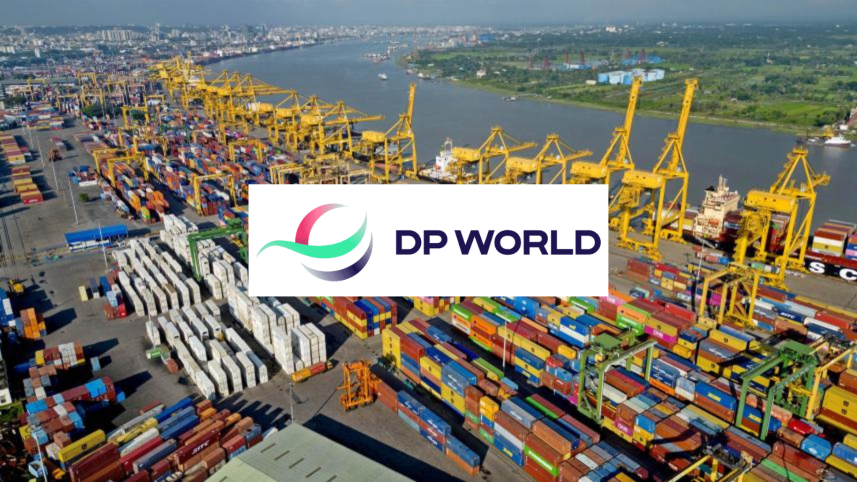
After decades of resistance to foreign terminal operators, Bangladesh has granted a global port giant control of its largest functional container terminal’s operations. The agreement marks a turning point in port policy—but its economic benefits will depend on transparency, performance and public accountability.
A long-running contest over who should operate Bangladesh’s principal seaport has entered a new phase, with the government signing a 15-year concession agreement with Dubai-based DP World to operate and maintain the New Mooring Container Terminal (NCT) at Chattogram Port.
The deal, signed on October 8, represents a significant shift in Bangladesh’s port-management policy. For decades, proposals to bring international terminal operators into Chattogram faced resistance from labour organisations, political groups and other stakeholders concerned about national control, employment and the future of a strategic public asset.
With the agreement now signed, the debate has moved from whether a foreign operator should be brought in to how the arrangement will work, what Bangladesh will gain and how the government will ensure that the public interest is protected.
The Chattogram Port Authority (CPA) will retain ownership of the terminal, its land and infrastructure, while DP World will receive the right to operate and maintain the facility for 15 years under a public-private partnership framework. The distinction is important: the agreement transfers operational responsibility, not ownership of the terminal.
The NCT is central to the stakes involved. Built in 2007 at a cost of around Tk 2,000 crore, it has five jetties and 14 of the port’s 18 quay-side gantry cranes. It handles more than 40 per cent of Chattogram Port’s container traffic, making the concession one of the most consequential changes in the management of Bangladesh’s trade infrastructure.
The government says the arrangement will introduce modern equipment, digital systems and international operating practices to improve productivity, reduce delays and strengthen Bangladesh’s links with global supply chains. Critics, however, have questioned the decision to appoint a foreign operator to an already functioning and commercially important terminal, arguing that the public needs greater clarity on the agreement’s terms, the distribution of revenue and the safeguards for workers and national interests.
The agreement therefore marks more than a change of operator. It is the latest chapter in a decades-long struggle between a model centred on domestic public-sector management and one that gives international companies a larger role in operating port infrastructure.
From public ownership to global terminal operators
The internationalisation of port operations gathered momentum from the 1980s onward, as governments sought private investment, specialised management and new technology to expand port capacity and improve efficiency. During the following decades, major terminal operators built international networks, managing facilities across multiple countries and connecting individual ports to global shipping and logistics systems.
Companies such as Hong Kong-based Hutchison Ports, Singapore’s PSA International, Denmark’s APM Terminals and Dubai-based DP World became prominent players in this transformation.
The model does not necessarily require a country to sell its port. Under the commonly used landlord-port model, the state retains ownership of the land and core infrastructure, while a private operator manages a terminal under a concession agreement. Depending on the contract, the operator may invest in equipment, introduce technology, employ workers and share revenue with the port authority.
The World Bank has argued that private-sector participation can help improve port performance in South Asia, but it has also stressed the importance of transparent concession bidding, stronger port-authority governance and competition between operators. Private participation, by itself, does not guarantee efficiency or protect the public interest.
For Bangladesh, this transition has been particularly contentious. Chattogram Port has traditionally combined the roles of infrastructure owner, operator and regulator, while private companies have carried out cargo-handling activities under contracts with the CPA. A 2016 World Bank study noted that Chattogram had not adopted the landlord model used by several other regional ports and described previous attempts to bring in international terminal operators that failed to materialise.
The DP World agreement is therefore not an isolated commercial decision. It is part of a gradual restructuring of how Bangladesh intends to manage and expand its port infrastructure.
SSA Marine: the earlier attempt that failed
The history of foreign terminal operations at Chattogram goes back to the late 1990s, when US-based stevedoring company SSA Marine sought permission to develop a container terminal near the Karnaphuli River.
According to the World Bank’s account, the proposal initially received approval, but a series of labour-union strikes paralysed port operations and forced the company to put its plans on hold. The initiative was revived after a change of government in 2001, only to face another challenge in 2003, when trade unions took the approval to the High Court.
The legal challenge succeeded on grounds concerning the legal status of SSA Marine’s joint venture, and the project did not proceed.
The episode established a pattern that would reappear in subsequent years: proposals for international participation at Chattogram would encounter not only commercial and administrative questions but also disputes over labour, legal authority and national control.
In 2010, the CPA initiated another concession process. The World Bank’s report, citing industry reporting, said the shortlist was reported to include leading international operators such as PSA International, APM Terminals, Hutchison and ICTSI. The process was subsequently cancelled.
These failed efforts meant that, for years, Chattogram remained outside the regional shift towards internationally managed container terminals, even as the volume of Bangladesh’s trade grew.
PCT opened the door
A major change came with the Patenga Container Terminal PCT. In December 2023, the CPA signed a 22-year concession agreement with Red Sea Gateway Terminal International (RSGTI), a Saudi-linked operator, to equip, operate and maintain the terminal.
Commercial operations began in June 2024, when a container vessel berthed at Patenga under the new operator. It marked the first time a foreign company was entrusted with operating a terminal at Bangladesh’s principal seaport.
The Patenga agreement provided a practical precedent for a foreign operator working within a port that remained under public ownership. It also shifted the discussion from whether international operators could be admitted to how their role should be structured.
The next major step was the Laldia Container Terminal project. In November 2025, the CPA signed a concession agreement with APM Terminals, part of Denmark’s A.P. Moller–Maersk group, and local partner QNS Container Services Ltd.
Unlike the NCT arrangement, which concerns an existing terminal, the Laldia project involves designing, financing, building and operating a new facility. The announced investment exceeds US$550 million, and the concession provides for 30 years of operation, with an extension tied to performance indicators. The project is expected to add more than 800,000 TEUs of annual container-handling capacity.
Together, Patenga, Laldia and NCT indicate that international terminal operators are becoming a more established feature of Bangladesh’s port-development strategy. The projects differ in investment structure and responsibilities, but all raise the question of how the government can combine outside expertise and capital with public ownership and accountability.
Why the NCT concession is more contentious
The NCT agreement is particularly significant because it concerns an existing, functioning terminal rather than a new facility requiring substantial construction.
Saif Powertec had operated the terminal for years. After its contract expired on July 6, 2025, Chittagong Dry Dock Ltd, a Bangladesh Navy-run company, took over operations the following day. The proposal to appoint an international operator subsequently faced opposition from labour organisations and groups campaigning to protect the port from foreign control.
Opponents questioned why an important and commercially active terminal should be placed under a foreign concession when local operators had been involved in its management. Some also argued that international participation should be directed towards facilities requiring new investment rather than an existing terminal already handling a substantial share of the port’s containers.
The government’s position is that DP World can bring operational expertise, equipment, digital systems and access to a global logistics network to improve terminal performance. The company has said it will work with the CPA on berth planning, yard management, equipment utilisation, maintenance, safety and sustainability.
The central question is not simply whether DP World is foreign-owned. It is whether the concession will deliver measurable improvements that justify the terms granted to the operator.
The financial terms and the public-interest test
Details reported after the signing point to a substantial financial commitment by DP World. According to The Business Standard, the company is to pay the CPA around Tk 600 crore at the beginning of the agreement and invest more than Tk 1,000 crore in the terminal during the first decade. The reported terms also include revenue sharing, a minimum annual container-handling guarantee and performance indicators intended to measure operational improvements.
These provisions matter because the NCT is not an untested or undeveloped site. It is an established public asset built with public funds and already central to Bangladesh’s container trade.
The crucial questions include how the revenue-sharing formula works in practice, which income streams and deductions are covered, what happens if performance targets are missed, and how effectively the CPA can enforce the agreement. The public also needs clarity on the scope of the operator’s investment commitments, the consequences of non-performance and the arrangements for protecting existing employees.
The reported financial terms provide some indication of the government’s expected return, but the full concession agreement and its detailed schedules are needed to assess the distribution of commercial risks and benefits comprehensively. Public summaries alone cannot establish whether every provision adequately protects Bangladesh’s interests.
Transparency is especially important because the CPA is both the asset owner and the public authority responsible for oversight. An international operator may have strong incentives to improve throughput and productivity, but public accountability depends on the quality of the contract, the independence of monitoring and the consequences for failing to meet obligations.
Maheshkhali and the future of foreign participation
The debate over foreign involvement extends beyond Chattogram’s existing terminals to Bangladesh’s ambition to develop a deep-sea port at Matarbari, in the Maheshkhali area of Cox’s Bazar.
An earlier proposal to develop a deep-sea port at Sonadia, near Maheshkhali, did not proceed. Bangladesh subsequently pursued the Matarbari project with Japanese financial and technical support. The distinction between infrastructure development and terminal operation is important: the participation of foreign contractors in building port facilities does not, by itself, mean that a foreign company has been awarded the right to operate the completed port.
DP World’s possible role in the wider Matarbari area emerged in April 2025, when Bangladesh Investment Development Authority (BIDA) chief Ashik Mahmud bin Harun disclosed discussions about establishing a free trade zone near the deep-sea port, drawing on the model of the Jebel Ali port and free zone in Dubai. The discussions were reported as a proposal for developing an economic zone; they did not establish that DP World had secured a concession to operate Matarbari port.
The broader direction is nevertheless clear: Bangladesh is exploring ways to attract international expertise and investment into ports, logistics and related economic infrastructure. The challenge will be to ensure that different projects are assessed on their own merits, with clear distinctions between construction contracts, terminal concessions and the management of adjacent economic zones.
Internationalisation has advanced; accountability remains decisive
The signing of the NCT concession closes one chapter in the long debate over international terminal operators at Chattogram Port. The failure of the SSA Marine proposal, the introduction of RSGT at Patenga, the APM Terminals agreement for Laldia and now the DP World concession illustrate how the policy has evolved from repeated attempts and resistance towards a broader role for foreign operators.
But internationalisation should not be confused with a guarantee of better performance. The outcome will depend on whether the agreements improve productivity, reduce vessel and cargo delays, lower the indirect costs faced by importers and exporters, and provide the CPA with a fair and transparent return on its assets.
The government will also need to ensure that labour protections are enforced, service standards are independently monitored and contractual obligations can be scrutinised. Where a single terminal accounts for such a large share of national container traffic, operational failures or poorly designed contractual arrangements could have consequences well beyond the port gates.
The 15-year concession gives DP World a substantial role in the management of one of Bangladesh’s most important trade facilities. It does not remove the state’s responsibility for safeguarding public assets or ensuring that port users benefit from any promised improvements.
The policy direction has shifted towards international operation. Whether that shift becomes an economic success for Bangladesh will be determined not by the identity of the operator, but by the performance, transparency and public value of the agreement.
