



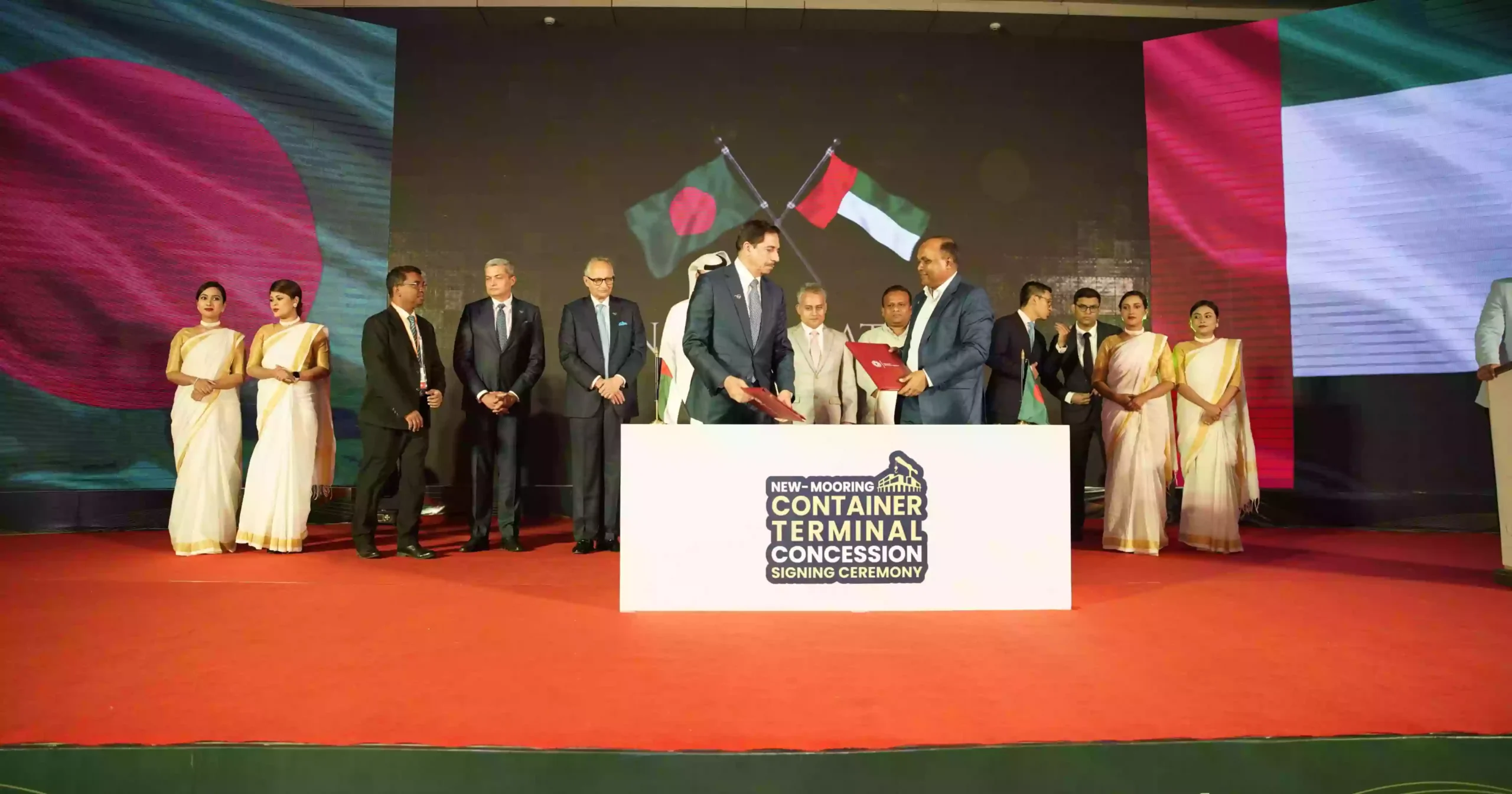
In a landmark development for the nation’s logistics and export-driven economy, Bangladesh has officially signed a transformative 15-year concession agreement with Dubai-based global port operator DP World to manage and modernise the New Mooring Container Terminal (NCT) at Chattogram Port.
The high-profile agreement was formally executed on Thursday at the Invest Bangladesh auditorium in Agargaon, Dhaka, following years of planning, rigorous reviews, and strategic negotiations facilitated by the International Finance Corporation (IFC) as the lead transaction adviser.
The signing ceremony took place in the presence of key government dignitaries, including Shipping Minister Shaikh Rabiul Alam, State Minister for Shipping Md. Rajib Ahsan, UAE Ambassador to Bangladesh Abdulla Ali Al Hamoudi, and Invest Bangladesh Chairman Ashik Chowdhury. Rear Admiral Md. Moniruzzaman, Chairman of the Chattogram Port Authority (CPA), signed the accord on behalf of the state, alongside Essa Kazim, Chairman of DP World’s Board of Directors.
Strategic Vision and Economic Imperative
Chattogram Port serves as Bangladesh’s premier maritime gateway, handling roughly 92 percent of the nation’s sea-borne foreign trade. Within the port complex, the NCT is the crown jewel—featuring five berths and managing approximately 44 percent of the port’s total container traffic.
However, persistent bottlenecks have weighed heavily on national competitiveness. In the recent Container Port Performance Index (CPPI) published by the World Bank and S&P Global, Chattogram Port ranked 364th out of 400 global container ports. Average container dwell times at the NCT currently exceed nine days—vastly trailing regional benchmarks where dwell times are under two days—while vessels spend more than 2.5 days at berth compared to 15 to 24 hours at modern international facilities.
Industry data estimates that these structural inefficiencies cost the national economy upwards of Tk 10 crore per day (exceeding BDT 3,000 crore annually). World Bank studies indicate that reducing container dwell times at Chattogram by just a single day could boost Bangladesh’s exports by up to 7.4 percent.
To bridge this gap, the government has embarked on a bold strategy to introduce world-class operators. Shipping Minister Shaikh Rabiul Alam emphasized that bringing in multiple reputed global operators will foster healthy competition, enhance supply chain resilience, and modernize infrastructure.
Investment, Modernisation, and Safeguarding National Interests
Under the terms of the 15-year public-private partnership (PPP) agreement:
-
State Ownership Maintained: Full ownership, land, and regulatory control of the terminal and its underlying infrastructure remain strictly with the state-run CPA and the Government of Bangladesh.
-
Significant Financial Injection: DP World will pay a substantial upfront fee of approximately Tk 600 crore to the government, alongside a commitment to invest over Tk 1,000 crore within the first decade for terminal upgrades, heavy equipment procurement, and advanced digital logistics technologies.
-
Ongoing Revenue & Accountability: The CPA will receive an annual fixed fee coupled with a share of operational revenues. The contract mandates strict Key Performance Indicators (KPIs), regular reporting standards, and financial penalties for missed operational targets.
-
Security & Local Workforce: Existing security protocols remain securely under the jurisdiction of the Bangladesh Navy, Coast Guard, Customs, and Immigration authorities. Furthermore, DP World will retain local port workers while introducing rigorous international training programs.
DP World Executive Chairman Essa Kazim noted, “Bangladesh is an increasingly important trading and manufacturing economy. By combining our operational expertise, technology, and end-to-end logistics capabilities, we aim to support trade, attract investment, and create new opportunities for businesses across the country.”
Overcoming Hurdles and Paving the Future
The path to finalising the agreement was marked by extensive discourse and occasional local opposition, with labour groups and stakeholders expressing initial concerns. However, through transparent stakeholder engagement and refined negotiations, the interim and current administrations successfully aligned the project with national interests.
Sectors such as readymade garments (RMG), agricultural products, processed goods, and light engineering are projected to be the primary beneficiaries of streamlined port operations, faster vessel turnaround, and lowered overall logistics costs.
DP World joins Saudi Arabia’s Red Sea Gateway Terminal (RSGT)—which operates the Patenga Container Terminal (PCT)—as the second major international operator entrusted with terminal management at Chattogram. Meanwhile, Denmark’s APM Terminals is progressing with a fifth facility, the Laldia Container Terminal (LCT), targeted for completion by 2030.
With these visionary steps, Bangladesh is firmly positioning its logistics network to meet “global speed” standards, unlocking unprecedented economic growth and transforming its primary maritime artery into a world-class trade engine.
