



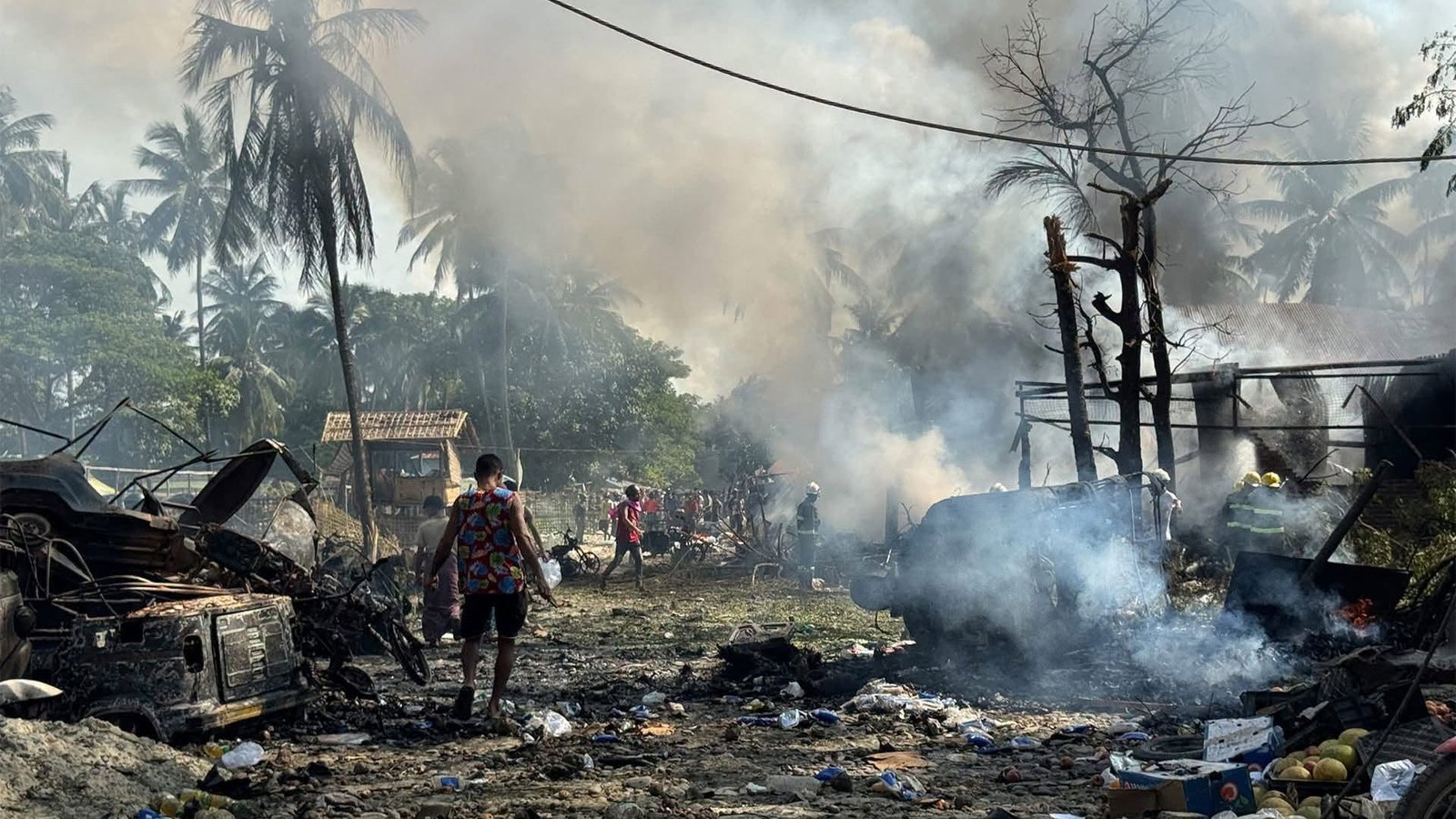
A Myanmar military airstrike on a crowded market in northern Rakhine has killed at least 49 people and wounded 58 others, according to updated reports, with Rohingya civilians, including children, reportedly among the victims, raising fresh concerns in Bangladesh over the worsening humanitarian situation and prospects for the safe and voluntary repatriation of more than 1.2 million refugees.
The Arakan Army initially reported 33 deaths and 36 injuries following Monday’s airstrike in Kyauktaw township, while Rohingya leader Maung Tun Kin, based in Europe, said at least 13 Rohingya were killed or missing, including children aged nine to 16. The Rohingya-specific casualty figures have yet to be independently verified.
Kyauktaw, a major town in northern Rakhine State, lies approximately 70–80 kilometres inside Myanmar from the Bangladesh border, placing the latest violence in a region of direct concern to Dhaka.
The attack has renewed attention to the deteriorating security and humanitarian situation in Rakhine, the ancestral homeland of the Rohingya, where armed conflict, displacement, food shortages and restrictions on movement have compounded the community’s longstanding vulnerability.
For Bangladesh, which has hosted Rohingya refugees since successive waves of forced displacement from Myanmar, the latest violence underscores the continuing obstacles to creating conditions for their safe, dignified and voluntary return.
Rohingya caught in escalating conflict
The market in Kyauktaw is a major wholesale centre serving traders and consumers from across Rakhine. A fighter jet reportedly dropped two bombs near the market, setting buildings ablaze, damaging vehicles and destroying parts of a nearby bridge.
Wai Hun Aung, a senior rescue official in Rakhine, confirmed the casualties, describing the incident as one of the most severe airstrikes in the state.
The Myanmar military did not immediately comment on the attack. It has previously maintained that its operations target legitimate military objectives while accusing resistance groups of terrorism.
The reported Rohingya casualties add another dimension to the crisis, as the community continues to face violence and insecurity amid the conflict between Myanmar’s military and ethnic armed organisations.
Maung Tun Kin, in a Facebook post, called for those responsible for attacks on civilians to be held accountable, arguing that the international community’s prolonged failure to prevent abuses has cost lives.
Repatriation prospects under renewed strain
The latest attack comes at a critical time for Bangladesh’s efforts to resolve the Rohingya crisis through repatriation.
More than 1.2 million Rohingya refugees remain in Bangladesh, predominantly in camps in Cox’s Bazar, after fleeing military persecution and violence in Myanmar, particularly during the mass exodus of 2017.
Dhaka has consistently maintained that repatriation to Myanmar is the only sustainable solution to the protracted refugee crisis, while insisting that returns must be voluntary, safe, dignified and accompanied by guarantees of rights and security.
However, the continued fighting in Rakhine, where the Arakan Army has gained control of large areas, complicates the prospects for organised repatriation.
The military has lost control of strategically important positions and most of Rakhine’s townships to the Arakan Army, while imposing severe restrictions on trade routes. The resulting disruption has worsened food shortages and humanitarian conditions.
Nearly half a million people have been displaced within Rakhine by the conflict, according to United Nations data.
The situation raises questions over who can guarantee the security, freedom of movement and basic rights of returning Rohingya, particularly in areas where control has shifted from the Myanmar military to the Arakan Army.
Bangladesh faces continuing humanitarian and security concerns
The violence also carries implications for Bangladesh’s border management and humanitarian responsibilities.
Further deterioration in Rakhine could create additional displacement pressures along the Bangladesh-Myanmar frontier, while prolonging the refugee crisis and increasing the demands on already stretched humanitarian resources.
Bangladesh has repeatedly called on the international community to intensify diplomatic pressure on Myanmar and address the root causes of Rohingya displacement.
The latest airstrike also highlights the broader risks facing civilians as Myanmar’s post-coup conflict enters another phase of prolonged instability.
Since the military takeover in February 2021, the country has descended into widespread armed conflict involving the military, pro-democracy resistance groups and ethnic armed organisations. The conflict has killed more than 100,000 people, according to the Armed Conflict Location and Event Data project.
The United Nations warned in August that Myanmar’s human rights situation had fallen to a new low, citing abuses against the Rohingya and the devastating effects of illicit economic activities.
A similar military airstrike on a hospital in Mrauk-U township in December last year killed at least 33 people and wounded dozens more.
International accountability in focus
For Bangladesh, the latest incident reinforces the importance of international efforts to ensure civilian protection, accountability for alleged violations and a political resolution to the conflict.
The Rohingya crisis is already before the International Court of Justice, where Myanmar faces allegations of violating the Genocide Convention in proceedings initiated by The Gambia.
The continuing violence in Rakhine adds urgency to international diplomatic and humanitarian engagement, particularly as the prospect of a durable political settlement remains uncertain.
Without credible security guarantees, protection of fundamental rights and an inclusive political arrangement, the conditions necessary for sustainable Rohingya repatriation are likely to remain elusive.
For the more than one million refugees living in Bangladesh, Monday’s airstrike is another reminder that the crisis in their homeland remains unresolved.
