



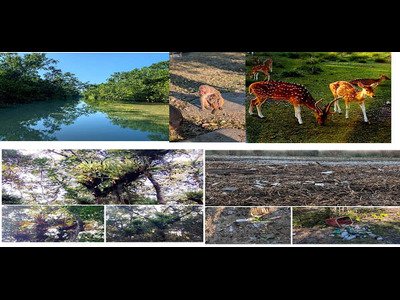
Sundarbans, world’s largest contiguous mangrove forest, is undoubtedly a natural gift to Bangladesh. Its dense vegetation works not only as anair purifier, shelter and food source of wild animals, but also as a shield for the coastal regions of Bangladesh during natural disasters.
It is located in the south-western part of Bangladesh and extends into the southeastern part of India. Bangladesh owns 60% of the forests. The government has divided Sundarbans into four distinct administrative ranges: Khulna range (parts Khulna district), Satkhirarange (parts of Satkhira district) and Chandpaiand Sarankhola ranges of Bagerhat district. The forests of Sundarbans are rich in diverse plants, animals and aquatic life. It is home to various mammal species including the world famous The Royal Bengal Tiger, reptiles and bird species and supports several plant species along with the Sundri, Gewa, Goran and Keora.
Recently, our team visited several areas of Sundarbans as a part of 3rd year field work of Department of Geography and Environmental Studies, University of Chittagong.Our study area covered Andharmanik, Kotka-Jamtola, Dimer Char, Dublar Char, Nilkamaland Karamjal of Sundarbans where various types of degradationsweredisclosing the pitiful condition of Sundarbans.
The name Sundarbans is thought to be derived from ‘Sundri’ trees that are abundant in that area. And those Sundri trees are now being extensively attacked by epiphytes, especially in Andharmanik. The trees have a history of ‘topdying’ disease due to the increasing salinity in that area. A new issue added with that, epiphytic surge.The epiphytes are suspected to be Bird’s nest fern (Asplenium nidus)and ferns from Drynaria genus, though there is no officialconfirmation yet.
Sundri trees naturally thrive in fresh and less saline water.Gorai river,the main tributary of Ganges supplies freshwater to Passur and Sibsa river which play a vital role in the Sundarbans’ ecosystems.In the past few decades, there has been a significant decrease in freshwater inflow from the Ganges through Gorai river into Passur river due to the water diversification by Frakka Barrage in India.Reduced freshwater discharge from upstream together with rising sea levels increased the concentration of salt in the soil and water making Sundri trees vulnerable to diseases and epiphytic attacks.These parasitic plants are absorbing the nutrients away, as a result, Sundri trees are weakening, drying out and eventually dying.Forest Department officials stated that 25%-30% Sundri trees are infected with parasitic plants. At this rate, Sundarbans will be devoid of Sundri trees in future.Proper investigations and researches are yet to be conducted about this crisis.
Another concern about Sundarbans is increasing plastic pollution.Bangladesh Government imposed a ban on single-use plastics in Sundarbans since March 2023. But it doesn’t seem to be effective, scattered plastics have been found in almost every areaof Sundarbans. In ‘Dimer Char’, large amount of plastic waste was seen deposited along with plant seeds by tides. Plastics dumped by tourists were seen piled up in ‘Kotka’.
The cities around Sundarbans produce and use a large amount of plastics every day. Plastic waste from nearby localities and factoriesare dumped into the rivers; those wastes flowtoward the Bay of Bengal and eventually end up in the Sundarbans with tidal waters. Unmonitored tourist activities are also responsible for this problem. A local tour guide, who has been working in that area for 15 years stated, “We always try to prevent tourists from taking single-use plastics in the forests. Sadly, we do not get any help from the government regarding waste disposal from the forest.”
In 2022, a joint study by Nalanda university and Central University of Jammu of India and Noakhali Science and Technology University of Bangladesh reported that about 4 million tons of micro-plastics have been annually discharged from various rivers of India and Bangladesh to Sundarbans and the Bay of Bengal.The increasing plastic pollution poses a great threat for the biodiversity and wild life as well as marine life of Sundarbans. The soil is losing fertility,wild animals often mistake plastic debris as food.In recent times, micro-plastics were found in the fishes of that area which eventually enter in human food chain.
Call for Action:
Climate change impacts and human activities are risking the forests of Sundarbans. The accelerating salinity, epiphytic spread, rising sea levels, land mass declining and plastic pollution have reached to an alarming stage. Unfortunately, no strong action has been taken till now to overcome these problems. We urge the Forest Department to take immediate action on identifying reasons behind epiphytic surge in Sundri trees, preventing further spread and conserving the species. Government needs to come out with a solution about freshwater flow in the rivers of Sundarbans. The plastic discharge in that area needs to be controlled as well.Furthermore, tourism there should be eco-friendly and well-monitored by the authorities in order to avoid more loss.
Sundarbans is a land of immense potential. It is a vital part of our environment and economy. Any kind of degradation in the forest affects Bangladesh directly. Forest declination will weaken the natural barrier against cyclones and tidal surges and leave the coastal communities more vulnerable to damages and loss of lives. Moreover, it will result habitat loss of wild animal and lead them towards extinction.Unawareness and lack of proper managements are resulting serious deterioration in the forests. Biodiversity and wildlife management and maintenance should be advanced and tourism should be more regulated to overcome this situation. It is high time we took proper initiatives to save our Sundarbans.
The authors are students, Department of Geography and Environmental Studies, University of Chittagong
