



Students from Bihari settlements overcome poverty through education, scholarships and skills training, while digital mathematics learning offers new opportunities
Every morning, Farha Begum enters a small classroom at OBAT Helpers Junior School in Segunbagan Colony in Pahartali, where children with special needs, including autism, gather for lessons, care and nutritional support.
For their families, bringing the children to school often comes with anxiety and uncertainty. Inside Farha’s classroom, however, the children settle into a calmer environment, appearing cheerful and eager to participate.
“The children are always eager to come here, and their parents bring them to school regularly. We teach them various skills to help develop their abilities, and we also provide them with nutritional support,” Farha says.
Her classroom captures the challenges facing some of Chattogram’s most marginalised communities—and the possibilities that emerge when education is combined with care, nutrition and long-term support.
The school serves a community whose history is intertwined with the 1947 Partition of the Indian subcontinent. Segunbagan Colony is home to many people commonly known as Biharis, whose families migrated from different parts of the subcontinent. Many waited for years to return to Pakistan before eventually accepting Bangladeshi citizenship.
For generations of children growing up in these settlements, poverty and limited access to educational opportunities have presented formidable barriers. OBAT Helpers, a voluntary organisation, is attempting to address those challenges through a combination of formal education, scholarships, digital learning and vocational training.
Education amid hardship
OBAT Helpers Junior School provides education up to Class Eight and has around 350 students, most from disadvantaged families living in Bihari settlements.
The pressure on its facilities is evident in a Class Eight classroom measuring just 10 feet by 10 feet, where more than 50 students attend lessons.
Many of them must balance education with the responsibility of earning money to support their families.
Syed Ibrar, a student in the class, works at a pharmacy for part of the day. With his father no longer alive, he helps support a family of five while continuing his studies.
His classmate Zahed Mamun works at a mobile phone repair shop. He hopes to open a repair business of his own, enabling him to earn a living and provide financial security for his family.
Sumona Akter has a different ambition. She wants to build a career in information technology and has already begun practising graphic design and web design while studying in Class Eight.
Their aspirations illustrate the role education can play in helping young people from disadvantaged backgrounds imagine a future beyond the immediate struggle to make ends meet.
OBAT Helpers is seeking to turn some of these ambitions into practical opportunities.
Sohel Akter Khan, Project Director of OBAT Helpers, says students who acquire marketable skills can receive support to establish themselves professionally.
“If Ibrar wants to open a pharmacy, Zahed Mamun wants to start a mobile phone repair shop, or Sumona wants to establish an IT-related business, we will help them. We have also informed their families about this support,” he says.
Digital mathematics reaches disadvantaged students
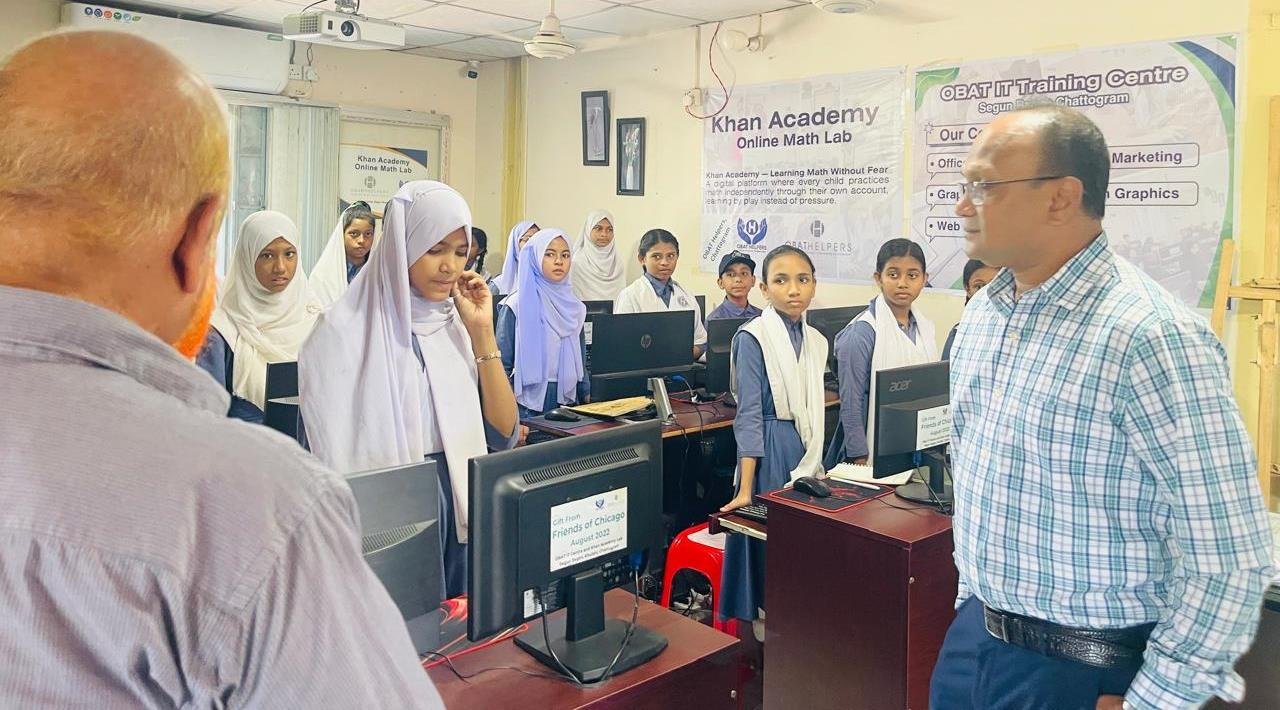
One of the organisation’s distinctive initiatives is its Khan Academy Online Math Lab, which has been operating in its schools since 2020.
Khan Academy is a free, open-access digital learning platform that enables students to study mathematics at their own pace, practise regularly and strengthen their understanding of fundamental concepts.
Each OBAT school has a dedicated mathematics lab where students use computers and internet access to engage with the platform.
Around 600 OBAT students are currently participating in the programme, which aims to reduce their fear of mathematics, strengthen foundational skills and expand access to technology-based education.
The initiative offers an alternative to conventional classroom instruction, allowing students to practise mathematical concepts repeatedly and progress according to their individual learning needs.
At the school, some of the teachers implementing the programme are former OBAT students themselves.
Amenа Akter, one of the teachers, says students are enthusiastic about the digital learning system and that many have made notable progress.
The participation of former students in teaching also reflects how educational opportunities can create a cycle in which beneficiaries eventually contribute to the learning of others in their community.
Four schools, 1,600 students
OBAT Helpers operates four schools in Chattogram, providing education to approximately 1,600 students, according to the organisation.
Its activities extend to Chhoto Gram and the Halishahar, Khulshi, Agrabad and Bayezid areas, where it also undertakes healthcare, sanitation and other development initiatives for disadvantaged children and families.
For students completing Class Eight at its schools, OBAT helps arrange admission to higher grades at other schools and institutions, including those run by the Underprivileged Children’s Educational Programs (UCEP), through partnerships.
Financial assistance and scholarships help students meet educational expenses and continue their studies beyond the institution’s own classrooms.
The organisation currently provides regular scholarships to around 600 students pursuing higher education at government colleges, universities and other educational institutions in Chattogram, including Chittagong University of Engineering and Technology (CUET).
Around 50 scholarship recipients have completed higher education and secured employment in different organisations, according to OBAT. Two have joined government service, while others include a textile engineer and an ICT teacher.
These outcomes demonstrate the potential of sustained educational support to help students from low-income households progress to higher education and employment.
Skills for economic independence
Beyond formal education, OBAT Helpers operates two computer training centres and one sewing training centre in Chattogram to help young people develop practical, employment-oriented skills.
The training is intended to improve their prospects in the job market and help them become financially independent.
The organisation also runs a Life Integration Programme that provides assistance to entire families rather than focusing exclusively on individual students. Support includes housing, education, healthcare and special assistance for elderly family members.
Sharmin Akter, a beneficiary of the programme, says her daughter completed her primary education at an OBAT school and is now studying at Government Nasirabad Girls’ High School, a well-known institution in Chattogram.
She hopes her daughter will pursue higher education.
“OBAT Helpers built a house for us, and my elderly mother-in-law receives a monthly allowance,” Sharmin says.
Her experience illustrates how support for housing and household welfare can complement education, helping families address some of the pressures that might otherwise disrupt a child’s studies.
Beyond the classroom
A visit to several classrooms at OBAT Helpers Junior School also reveals students demonstrating abilities in extracurricular activities, suggesting that their potential extends beyond the formal curriculum.
Yet the challenges remain visible: overcrowded classrooms, poverty-driven child labour and the difficulty of continuing education after the school’s highest grade.
For students such as Ibrar and Zahed, the prospect of opening a small business offers a path towards supporting their families. For Sumona, digital skills may provide an entry into the technology sector. For children in Farha Begum’s classroom, education combines learning with care and an opportunity to develop their abilities in a supportive environment.
OBAT Helpers’ experience in Chattogram suggests that educational access can be strengthened when classroom learning is linked to financial assistance, vocational skills, family support and digital tools.
larger challenge is to ensure that these opportunities reach more children—and that the progress made inside the classroom translates into lasting educational achievement, decent employment and greater economic security for families living on the margins of society.
